

Buying pre-order items
Ebooks and Audiobook
You will receive an email with a download link for the ebook or audiobook on the publication date.
Payment
You will not be charged for pre-ordered books until they are available to be shipped. Pre-ordered ebooks will not be charged for until they are available for download.
Amending or cancelling your order
For orders that have not been shipped you can usually make changes to pre-orders up to 72 hours before the publishing date.
Payment for this pre-order will be taken when the item becomes available
- Delivery and returns info
-
Flat rate of $10.00 for shipping anywhere in Australia
Description
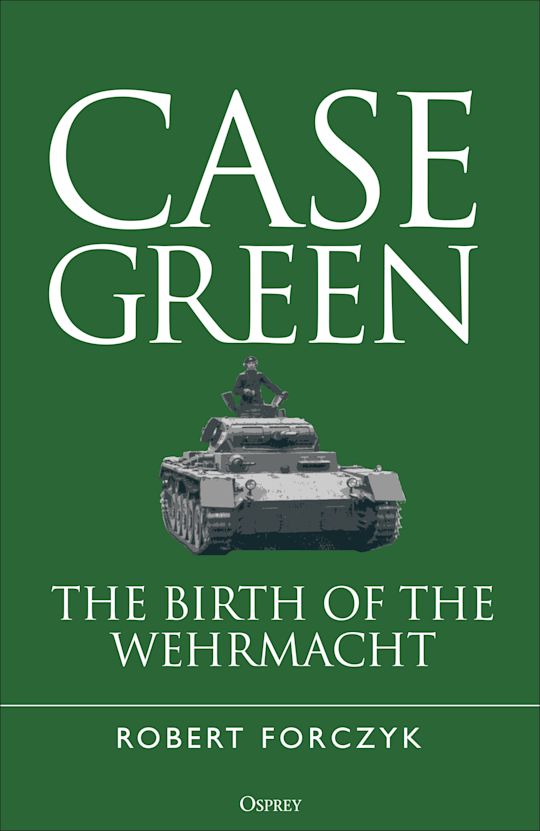
This fascinating new study from renowned historian Robert Forczyk tells the story of the Wehrmacht from its birth in 1935 through to the German occupation of Czechoslovakia in 1938.
Adolf Hitler rose to power in 1933 on the back of a populist agenda, and a promise to lead the nation back to unity, stability and prosperity. A key part of that was his promise to restore Germany's military which had been reduced to little more than a well-armed police force by the provisions of the Treaty of Versailles. Central to this was the formal establishment of the Wehrmacht, the newly renamed German Army, in 1935.
In this new military-focused study, renowned World War II historian Robert Forczyk traces the development and operations of the Wehrmacht from the announcement of rearmament in 1935 to the occupation of Czechoslovakia in 1938. He examines the critical trends and events in this period, including the growth of the new Panzer arm, as well as competing priorities with the Luftwaffe and Kriegsmarine. He looks at how Hitler ignored or trampled existing diplomatic agreements while directing a rapid and massive rearmament program in Germany, reoccupying the Rhineland in 1936, incorporating first Austria then the Sudetenland into the Reich by force in 1938 and finally seizing the remainder of Czechoslovakia, Memel from Lithuania and demanding the return of Danzig from Poland, leaving Europe on the cusp of World War II.
Table of Contents
List of Maps
Prologue
Introduction
Chapter 1: Genesis of the Czech State, 1198–1919
Chapter 2: Building the Czechoslovak Republic, 1920–33
Chapter 3: Czech Strategic Planning and Policy, 1919–34
Chapter 4: Germany Refuses to Accept Disarmament, 1923–33
Chapter 5: Czechoslovakia Recognizes the Approaching Danger, 1934–37
Chapter 6: Anglo-French Deterrence fails, 1933–37
Chapter 7: Hitler's Rearmament, 1934–38
Chapter 8: Die schwere Stunde (The Fateful Hour), 1938
Chapter 9: The Evolution of Fall Grün (Case Green)
Chapter 10: Assessment of Fall Grün
Chapter 11: The Possibility of Conflict Escalation
Chapter 12: Climax of the Munich Crisis
Chapter 13: Aftermath
Appendices
Glossary
Notes
Bibliography
Index
Product details
| Published | 02 Feb 2027 |
|---|---|
| Format | Hardback |
| Edition | 1st |
| Pages | 336 |
| ISBN | 9781472870025 |
| Imprint | Osprey Publishing |
| Illustrations | 16-page plate section in black and white |
| Dimensions | 234 x 153 mm |
| Publisher | Bloomsbury Publishing |
Reviews

ONLINE RESOURCES
Bloomsbury Collections
This book is available on Bloomsbury Collections where your library has access.
Related Titles