Dissents, Contradictions, and Ambiguities of the Soviet Unofficial Literature
The Impossible Community
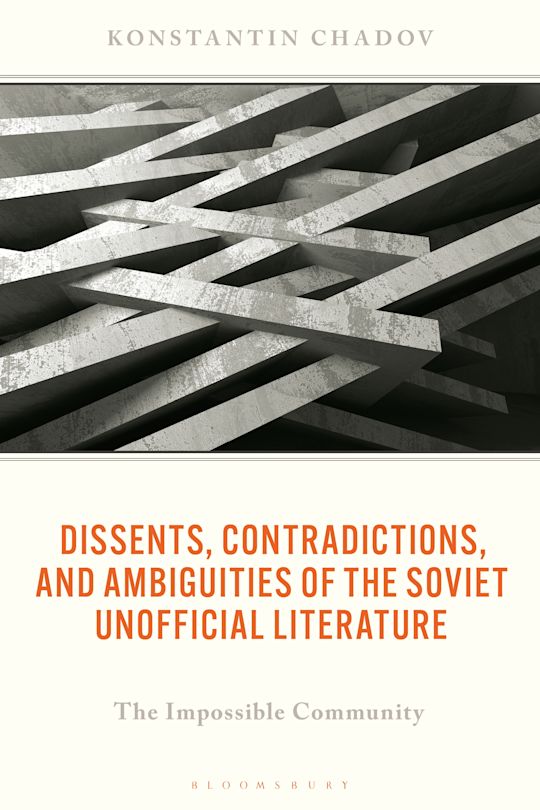

Dissents, Contradictions, and Ambiguities of the Soviet Unofficial Literature
The Impossible Community
Description
The book discusses the internal structure of the Soviet unofficial literary community of Leningrad in the 1970s and 1980s. Drawing on the concepts of Jacques Lacan, Alain Badiou, and Jacques Derrida, it describes the factors that contributed to the "loosening" of the community's stability – a task that requires tracing various forms of omission, contradiction, and ambiguity that constituted the community's life.
Dissents, Contradictions, and Ambiguities of the Soviet Unofficial Literature offers a reconsideration of two prevailing views of Soviet unofficial culture: first, that it was a series of friendship circles that turned their "pariah" status within the Soviet literary system into an artistic device; and second, that it was an "alternative social space", a kind of public sphere that fought against Soviet monologism. As the book shows, tensions within the community arose when these two regimes – that of friendly endeavor and that of public activity – were juxtaposed. After certain events in the mid-1970s, the community definitively entered the public sphere, with the obligation to produce "good enough works" (a fact that can be reconstructed with the help of structural psychoanalysis). However, the structure of the community remained rather amorphous, unsuited to such a task: for most, cultural production was still a kind of bohemian entertainment, not something that required collective effort.
Accessibility Information
Additional accessibility information
- EPUB 3.0
- Conforms with the requirements of EPUB Accessibility Spec v1.1
- WCAG level AA
- WCAG v2.2 compliant
- accessibility@bloomsbury.com
Hazards
The publication contains no hazards
Support for non-visual reading
- No accessibility features offered by the reading system, device or reading software are disabled or otherwise unusable with the product
- Has alternative text descriptions for images
Visual adjustments
Appearance of the text and page layout can be modified according to the capabilities of the reading system (font family and size, spaces, as well as color of background and text)
Navigation
- Page list to go to pages from the print source version
- Elements such as headings, tables, etc for structured navigation
- All or substantially all textual matter is arranged in a single logical reading order
- Content is enhanced with ARIA roles to optimize organization and facilitate navigation
- Purposes of all links are made clear
Rich content
Language tagging provided
Table of Contents
Chapter 1. How to think the "truth" of the (literary) community?
Chapter 2. The Unnerving Question of Being-Together in the Critical Writings of Leningrad Samizdat
Chapter 3. "This picture will fit us all". The Analysis of Viktor Krivulin and Aleksandr Ozhiganovs' Poetry
Chapter 4. The Conflict of Measurements: Popularity in the Community or the Public Success?
Chapter 5. Boris Ivanov and the Concept of "Cultural Movement"
Chapter 6. The Unity Crumbles, yet Persists, or the Drama of Text's (Non-)Belonging
Epilogue
Product details

| Published | 03 Sep 2026 |
|---|---|
| Format | Ebook (Epub & Mobi) |
| Edition | 1st |
| Pages | 224 |
| ISBN | 9781978771826 |
| Imprint | Bloomsbury Academic |
| Series | Crosscurrents: Russia's Literature in Context |
| Publisher | Bloomsbury Publishing |

ONLINE RESOURCES
Bloomsbury Collections
This book is available on Bloomsbury Collections where your library has access.
Related Titles