
Buying pre-order items
Ebooks and Audiobook
You will receive an email with a download link for the ebook or audiobook on the publication date.
Payment
You will not be charged for pre-ordered books until they are available to be shipped. Pre-ordered ebooks will not be charged for until they are available for download.
Amending or cancelling your order
For orders that have not been shipped you can usually make changes to pre-orders up to 72 hours before the publishing date.
Payment for this pre-order will be taken when the item becomes available
Description
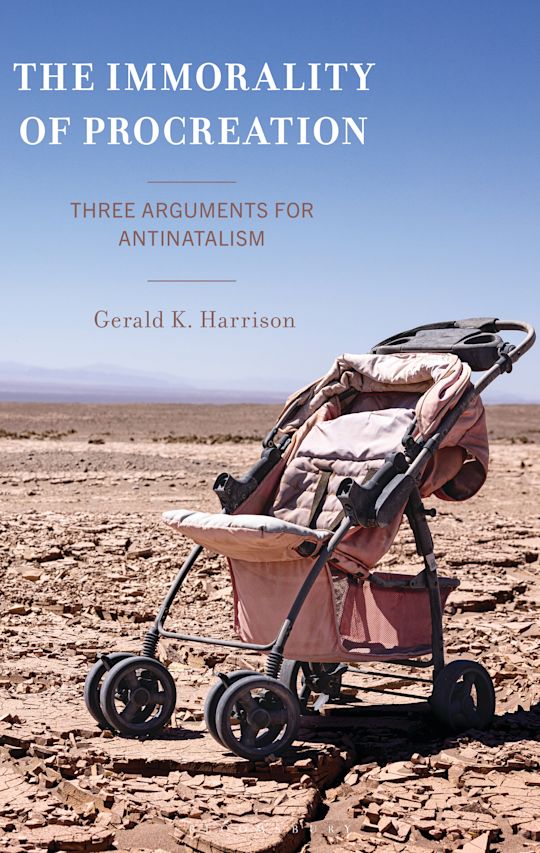
Offering a defense of antinatalism, this book builds a case based fundamental moral principles of consent, responsibility, and harm.
While sharing its conclusion-that procreation is morally wrong in ordinary circumstances-with earlier antinatalist works, the book develops a distinctive and largely optimistic case grounded not in the claim that life is inherently harmful, but in fundamental moral principles.
Gerald K Harrison offers three arguments. The first is that it is ordinarily wrong to impose significant and morally unnecessary burdens on an innocent person without that person's consent. Procreation, necessarily, imposes such burdens on an individual who could not have agreed to bear them. The second argument appeals to moral desert. By freely and unnecessarily creating a person, procreators bring into existence an individual who deserves certain goods, benefits, and protections. Since neither parents nor society can reliably guarantee what innocent persons deserve, can it be morally permissible to create them? The third argument focuses on mortality. Human beings inevitably face death, a prospect that reason represents as a profound and unavoidable harm. If procreation predictably exposes an innocent person to the possibility of extreme or enduring suffering, we must critically reassess its moral status.
The book also engages extensively with contemporary debates in reproductive ethics. It challenges David Benatar's influential asymmetry argument while offering new treatments of the non-identity problem, evolutionary debunking arguments, and the relationship between antinatalism and the problem of evil. Additionally, it responds to a wide range of objections concerning human extinction, economic necessity, meaning in life, suicide, and theism.
Accessibility Information
Additional accessibility information
- EPUB 3.0
- Conforms with the requirements of EPUB Accessibility Spec v1.1
- WCAG level AA
- WCAG v2.2 compliant
- accessibility@bloomsbury.com
Hazards
The publication contains no hazards
Support for non-visual reading
- No accessibility features offered by the reading system, device or reading software are disabled or otherwise unusable with the product
- Has alternative text descriptions for images
Visual adjustments
Appearance of the text and page layout can be modified according to the capabilities of the reading system (font family and size, spaces, as well as color of background and text)
Navigation
- Page list to go to pages from the print source version
- Elements such as headings, tables, etc for structured navigation
- All or substantially all textual matter is arranged in a single logical reading order
- Content is enhanced with ARIA roles to optimize organization and facilitate navigation
- Purposes of all links are made clear
Rich content
Language tagging provided
Table of Contents
Chapter 1: The Consent-Based Case
Chapter 2: The Case from Desert
Chapter 3. That Death is an Immense Absolute Harm
Chapter 4: The Endless Harm of Death
Chapter 5: Objections and Replies Part 1
Chapter 6: Objections and Replies Part 2
Conclusion
Bibliography
Index
Product details

| Published | 15 Apr 2027 |
|---|---|
| Format | Ebook (Epub & Mobi) |
| Edition | 1st |
| Pages | 224 |
| ISBN | 9781978766525 |
| Imprint | Bloomsbury Academic |
| Publisher | Bloomsbury Publishing |
Related Titles