

Buying pre-order items
Ebooks and Audiobook
You will receive an email with a download link for the ebook or audiobook on the publication date.
Payment
You will not be charged for pre-ordered books until they are available to be shipped. Pre-ordered ebooks will not be charged for until they are available for download.
Amending or cancelling your order
For orders that have not been shipped you can usually make changes to pre-orders up to 72 hours before the publishing date.
Payment for this pre-order will be taken when the item becomes available
Description
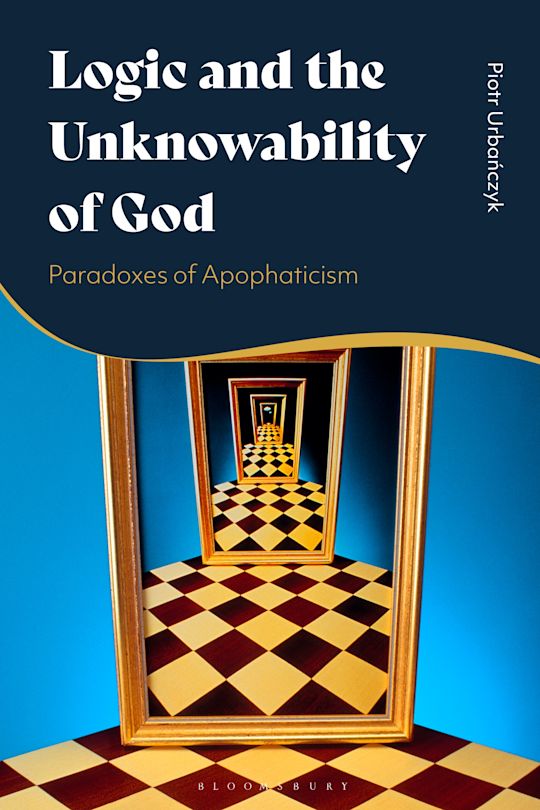
A rigorous analysis of the paradoxes of apophatic theology, revealing its deep logical structure and challenging inconsistencies.
In this book, Piotr Urbanczyk delves into the theory known as negative, or apophatic, theology where God is completely ineffable and unknowable. This doctrine, however, presents a paradox: if we declare that God is ineffable or unknowable, we are, in fact, asserting something about Him.
Investigating three interpretations of apophatic doctrine and highlighting the logical aspects accompanying each, Urbanczyk's interpretation of negative theology emphasizes the transcendence of God in the context of language. In the first part of the book, he reveals that the paradox lying underneath this theory has a self-referential structure characteristic of well-known semantic paradoxes. Another interpretation shifts from language to knowledge, claiming that God is completely unknowable. While "theological skepticism" seems similar to the ineffability view, Urbanczyk argues they are distinct. Using epistemic modal logic, he demonstrates that theological skepticism reflects classic epistemic paradoxes like Moore's problem, the Church-Fitch paradox, and the knower's paradox.
By applying formal logic to the analysis of this doctrine, Urbanczy's book shows how the reconstruction of negative theology can be incredibly beneficial.
Accessibility Information
Additional accessibility information
- EPUB 3.0
- Conforms with the requirements of EPUB Accessibility Spec v1.1
- WCAG level AA
- WCAG v2.2 compliant
- accessibility@bloomsbury.com
Hazards
The publication contains no hazards
Support for non-visual reading
- No accessibility features offered by the reading system, device or reading software are disabled or otherwise unusable with the product
- Has alternative text descriptions for images
Visual adjustments
Appearance of the text and page layout can be modified according to the capabilities of the reading system (font family and size, spaces, as well as color of background and text)
Navigation
- Page list to go to pages from the print source version
- Elements such as headings, tables, etc for structured navigation
- All or substantially all textual matter is arranged in a single logical reading order
- Content is enhanced with ARIA roles to optimize organization and facilitate navigation
- Purposes of all links are made clear
Rich content
Language tagging provided
Table of Contents
Part One: Semantic Aspect
1. Apophatic Theology as a Theology of Silence
2. Negation as a “Denial of All Beings”
3. Weak Ineffability
4. Universal and Existential Principles of Negative Theology
5. Semantic Principle of Negative Theology
6. Elements of Modal Logic in the Formal Reconstruction of the Ineffability Thesis
7. Classical Theory of Ineffability
8. Positive Negative Theology
Part Two: Epistemic Aspect
9. Ineffability vs. Unknowability. Note on the Relationships Between Language and Mind
10. Apophatic Theology as Theological Skepticism
11. Epistemic Paradoxes of Theological Skepticism
Part Three: Order-Theoretic Aspect
12. Negative Theology as Neoplatonically Inspired Mysticism
13. Formal Ontology for Neoplatonic Mysticism
Conclusion
Product details

| Published | 01 Oct 2026 |
|---|---|
| Format | Ebook (Epub & Mobi) |
| Edition | 1st |
| Pages | 248 |
| ISBN | 9781350549517 |
| Imprint | Bloomsbury Academic |
| Illustrations | 10 bw illus |
| Publisher | Bloomsbury Publishing |

Related Titles