The Post-9/11 Great American Novel
Fictional Perpetuations of White American Trauma and Islamophobia
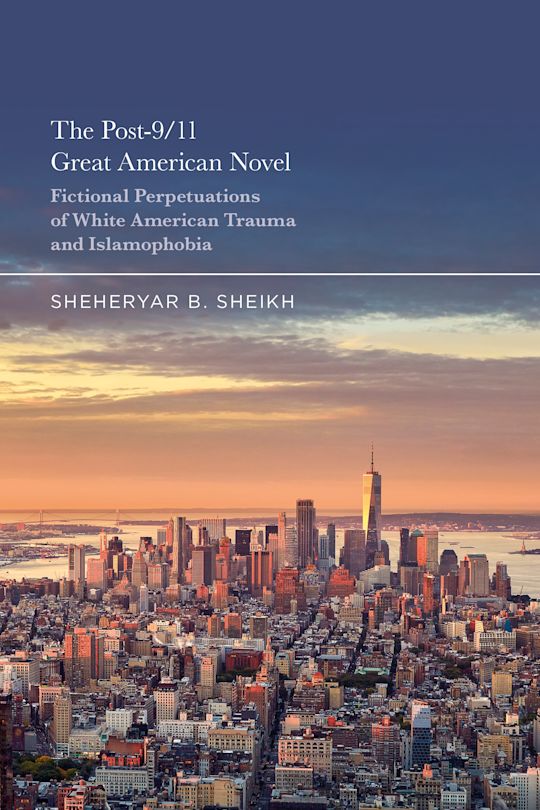


The Post-9/11 Great American Novel
Fictional Perpetuations of White American Trauma and Islamophobia
Buying pre-order items
Ebooks and Audiobook
You will receive an email with a download link for the ebook or audiobook on the publication date.
Payment
You will not be charged for pre-ordered books until they are available to be shipped. Pre-ordered ebooks will not be charged for until they are available for download.
Amending or cancelling your order
For orders that have not been shipped you can usually make changes to pre-orders up to 72 hours before the publishing date.
Payment for this pre-order will be taken when the item becomes available
This product is usually dispatched within 2-4 weeks following the publication date
- Delivery and returns info
-
Flat rate of $10.00 for shipping anywhere in Australia
Description
A study of the confluences between liberal white Americans' trauma, their reverting to hyper-conservative Islamophobia, and Don DeLillo's call to American authors that they compose a new so-called 'Great American Novel' pluriverse in the wake of 9/11.
In December 2001, Don DeLillo urged American writers to create “the counternarrative” that would reclaim control of culture in a call for nation-rebuilding fiction that mirrors John William de Forest's original post-Civil War coinage of the term and concept of the “Great American Novel.” Through this conceptual framework, Sheheryar Sheikh examines four major post-9/11 works to demonstrate a concerted effort by these authors to address the “Muslim Question” in novels that feature and critique traumatized white Americans creating mechanisms with which to mitigate the trauma of 9/11 as it resurges at even the thought of Muslims existing in America after 9/11.
By looking at repression, appropriation, adversarial othering, and enforced secularization as they appear in Jonathan Safran Foer's Extremely Loud & Incredibly Close, John Updike's Terrorist, DeLillo's Falling Man, and Amy Waldman's The Submission, this study shows the iterations of “solutions” and the abandonment of these ideals by traumatized white liberals. While the original concept of the Great American Novel featured fluid and multifaceted explorations of the American Dream, The Post-9/11 Great American Novel shows how this renewed interest in creating nation-rebuilding texts threatened to stagnate and calcify this literary form. Specifically, because these texts primarily congeal around the occlusion of Muslims and Islam within and from the United States.
Table of Contents
Introduction: New Connections to the American Project in Early Post-9/11 Literature
1. Creating Monsters Out of Trauma: The Failed Repression of Muslims and Islam in Extremely Loud & Incredibly Close
2. Americanizing 9/11: Appropriating and Repurposing Islamic Signifiers in Don DeLillo's Falling Man
3. Losing Their Religion: Enforced Secularization in John Updike's Terrorist
4. Not Exceptional Enough: The Occlusion of Muslims and the Quran in Amy Waldman's The Submission
Conclusion: The Ultimate End, and the Limits of the Post-9/11 Great American Novel
Bibliography
Index
Product details

| Published | 27 May 2027 |
|---|---|
| Format | Paperback |
| Edition | 1st |
| Pages | 240 |
| ISBN | 9798765134412 |
| Imprint | Bloomsbury Academic |
| Dimensions | 229 x 152 mm |
| Publisher | Bloomsbury Publishing |

Reviews

ONLINE RESOURCES
Bloomsbury Collections
This book is available on Bloomsbury Collections where your library has access.
Related Titles