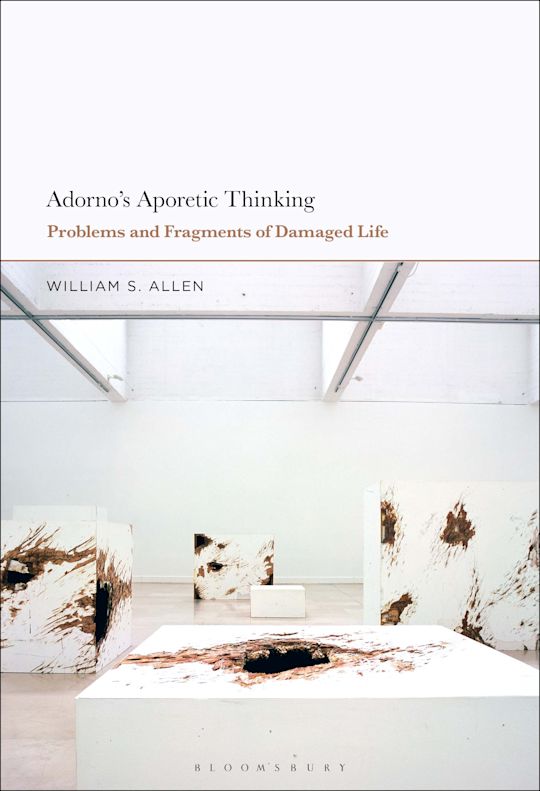

Description
Extending Adorno's aporetic worldview from Minima Moralia – that the problems of contemporary life find their response not through resolution but through reflection – to Adorno's other writings, this book offers an innovative new reading of how logic and literary form mutually inform Adorno's thought.
What do we do when we are faced with a problem that cannot be avoided or resolved? How does thought respond to such immovable obstacles? The blocks that are encountered in these terms are those that prevent life from realizing itself, and that consequently leave it stunted or disfigured. For Adorno, such problems are evidence of “damaged life,” which he sought to think through across several of his works, including Minima Moralia: Reflections From Damaged Life.
Adorno's Aporetic Thinking unfolds the peculiar mode of thinking that emerges as Adorno attempts to consider the aporetic issue of problems that cannot be simply overcome. Through extended readings of Adorno's works and texts by Kafka, Beckett, and Hegel as interlocutors, this book uncovers a form of thinking that responds to these blocks to life by way of the blocks themselves, which constitutes an aporetic thinking of damaged life, or a thinking of aporias through aporias.
Accessibility Information
Additional accessibility information
- PDF/UA-2, 1.4
- accessibility@bloomsbury.com
Hazards
The publication contains no hazards
Support for non-visual reading
Has alternative text descriptions for images
Navigation
- Page list to go to pages from the print source version
- Elements such as headings, tables, etc for structured navigation
- All or substantially all textual matter is arranged in a single logical reading order
Table of Contents
List of Abbreviations
Introduction: The Aporias of Damaged Life
Part I
Corroding Forms
Part II
1. Odysseus and the Sophist
2. Kafka's Step
3. Beckett Towards the End
4. Objects of Speculation
5. Life as an End in Itself
6. By Way of the Sirens
Notes
References
Index
Product details

| Published | 10 Dec 2026 |
|---|---|
| Format | Ebook (PDF) |
| Edition | 1st |
| Pages | 288 |
| ISBN | 9798216437840 |
| Imprint | Bloomsbury Academic |
| Publisher | Bloomsbury Publishing |
Reviews
Related Titles