
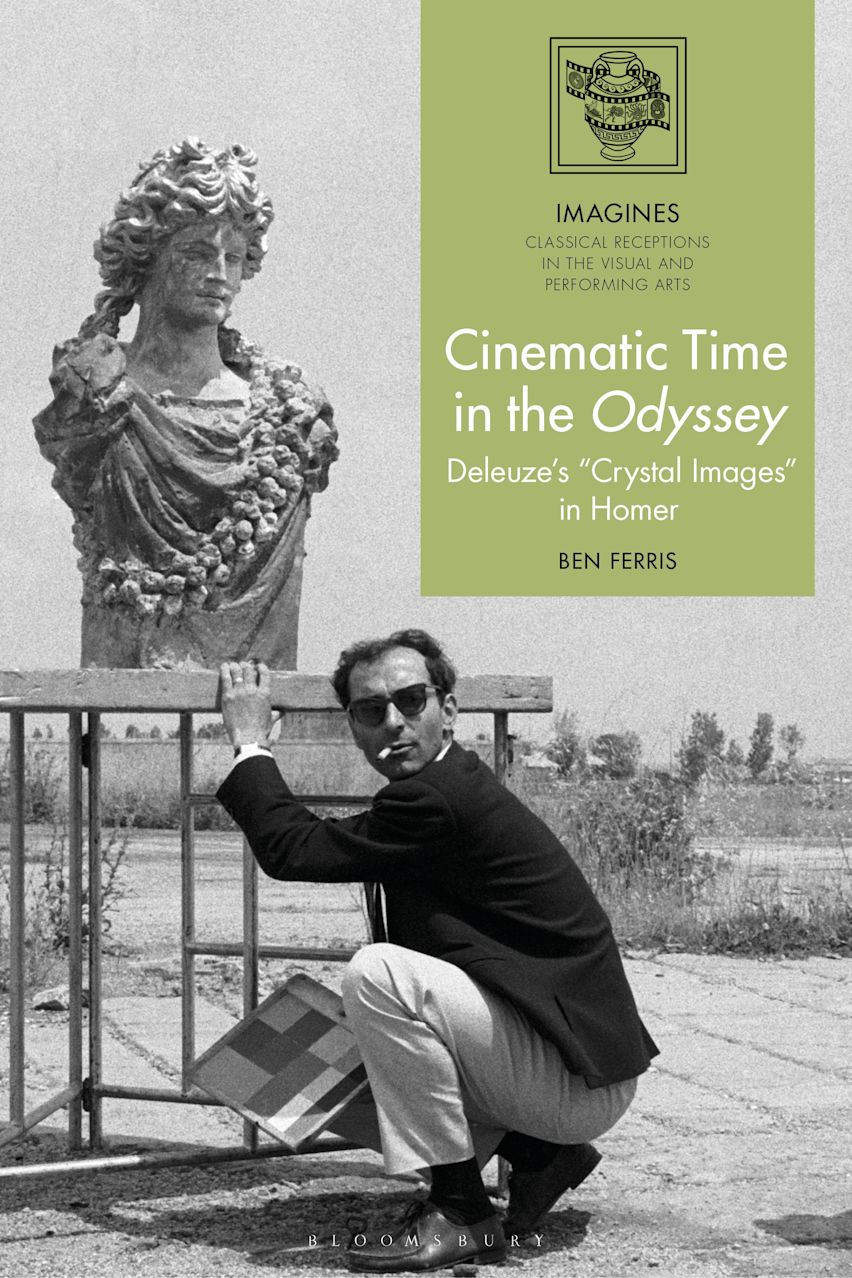
Description
This book explores Homer's Odyssey through Gilles Deleuze's philosophy and film theory, focusing on how time operates in the epic. Using Deleuze's concept of the “crystal image”, which holds past, present and future in suspension, it examines the Odyssey's temporal complexities alongside key films. Each chapter engages with a distinct aspect of time: metapoetics, trauma and the afterlife.
Alain Resnais' Last Year at Marienbad (1961) and Jean-Luc Godard's Contempt (1963) illuminate metapoetics, while Deleuze's concept of the “crystal image” reveals how films and the Odyssey interweave past, present and future. Case studies from both works highlight the temporal complexity of Homeric epic. Resnais' Hiroshima mon amour (1959) explores trauma, paralleling Odysseus' fragmented memories, while Theo Angelopoulos' Ulysses' Gaze (1995) and Coppola's Apocalypse Now (1979) engage with death, exile and return. By applying Deleuze's theory, modern films are placed in dialogue with ancient texts, offering fresh insights into Homeric temporality and the Odyssey's themes of metapoetics, trauma and death.
Accessibility Information
Additional accessibility information
- PDF/UA-2, 1.4
- accessibility@bloomsbury.com
Hazards
The publication contains no hazards
Support for non-visual reading
Has alternative text descriptions for images
Navigation
- Page list to go to pages from the print source version
- Elements such as headings, tables, etc for structured navigation
- All or substantially all textual matter is arranged in a single logical reading order
Table of Contents
Chapter 1: Time and Metapoetics: Odyssey Book 8 and Resnais' Last Year at Marienbad (1961)
Chapter 2: Time and Trauma: Odyssey Book 19 and Resnais' Hiroshima mon amour (1959)
Chapter 3: Time and Death: Odyssey Book 11 and Angelopoulos' Ulysses' Gaze (1995) / Coppola's Apocalypse Now (1979)
Conclusion: A Swallow's Song
Appendix A: A list of crystal-images in the Odyssey
Notes
Bibliography
Index
Product details

| Published | 21 Jan 2027 |
|---|---|
| Format | Ebook (PDF) |
| Edition | 1st |
| Pages | 240 |
| ISBN | 9781350579613 |
| Imprint | Bloomsbury Academic |
| Illustrations | 66 bw illus |
| Series | IMAGINES – Classical Receptions in the Visual and Performing Arts |
| Publisher | Bloomsbury Publishing |
Reviews
Related Titles