
Description
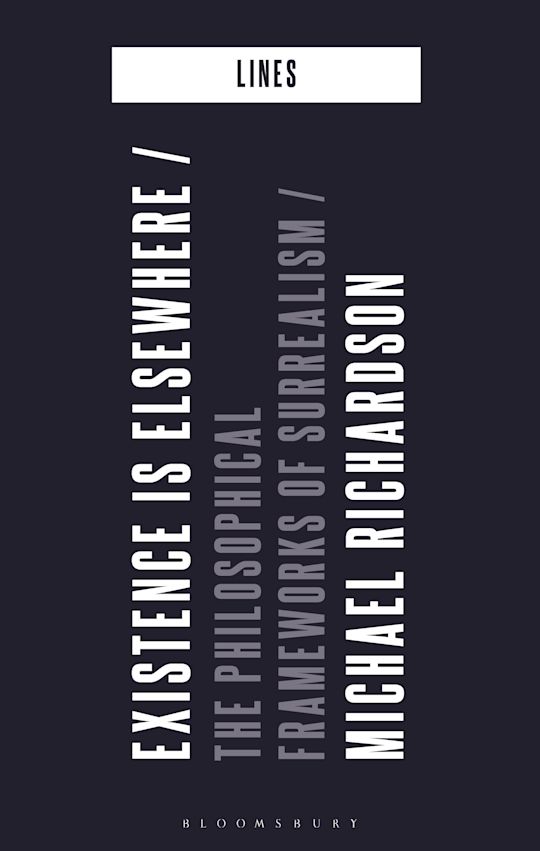
Existence is Elsewhere offers the first comprehensive account of surrealism as a movement sustained by philosophical ideas.
Moving far beyond the familiar narrative linking surrealism to Freud, this study reveals a century-long engagement with thinkers as diverse as Hegel, Heraclitus, Parmenides, Schelling, Novalis, Nietzsche, and Fourier, as well as traditions outside the Western canon, from ancient Egypt to Chinese thought.
Michael Richardson shows that surrealism was born of a network of encounters: collective experiments, shared crises after the First World War, and intense friendships that shaped its emergence between 1919 and 1924. Its philosophical orientation arose not from systematic study but from a “philosophical poetics” – a way of thinking through practice, intuition, and experiment.
Across ten chapters, Richardson traces surrealism's relationship with dialectical thinking, analogy, myth, and the marvellous. Hegel's ideas on mediation and becoming illuminate Breton's concerns with identity and recognition; Heraclitus' unity of opposites and Parmenides' journey into the unknown resonate with surrealism's pursuit of an “elsewhere” beyond perceptual reality; Schelling's philosophy of nature and the unconscious opens new vistas for understanding surrealism's animist sensibility, while Nietzsche's pessimism and affirmation of life sharpen its critique of modernity.
Existence is Elsewhere is an essential resource for readers in philosophy, literature, art history, and modern intellectual history, offering a bold reconceptualization of the history of surrealism, and what it may still become.
Accessibility Information
Additional accessibility information
- EPUB 3.0
- Conforms with the requirements of EPUB Accessibility Spec v1.1
- WCAG level AA
- WCAG v2.2 compliant
- accessibility@bloomsbury.com
Hazards
The publication contains no hazards
Support for non-visual reading
- No accessibility features offered by the reading system, device or reading software are disabled or otherwise unusable with the product
- Has alternative text descriptions for images
Visual adjustments
Appearance of the text and page layout can be modified according to the capabilities of the reading system (font family and size, spaces, as well as color of background and text)
Navigation
- Page list to go to pages from the print source version
- Elements such as headings, tables, etc for structured navigation
- All or substantially all textual matter is arranged in a single logical reading order
- Content is enhanced with ARIA roles to optimize organization and facilitate navigation
- Purposes of all links are made clear
Rich content
Language tagging provided
Table of Contents
1. Poetry and Philosophy in Nineteenth-century France
2. Hegel and the Surrealist Imagination
3. Intimations from Ancient Egypt
4. Heraclitus and the Dynamic of Existence
5. Parmenides and Existence as 'Other'
6. Schelling and the Ages of the World
7. Novalis and Poetry's Revolutionary Potential
8. The Spectre of Nietzsche
9. The Materiality of the World
10. Fourier and Utopian Vision
Bibliography
Appendix
Product details

| Published | 21 Jan 2027 |
|---|---|
| Format | Ebook (Epub & Mobi) |
| Edition | 1st |
| Pages | 240 |
| ISBN | 9781350531390 |
| Imprint | Bloomsbury Academic |
| Illustrations | 10 bw illus |
| Series | Lines |
| Publisher | Bloomsbury Publishing |
Reviews
Related Titles