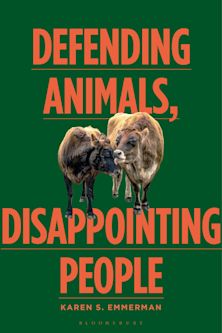


Description
When is it morally permissible to give up on people who are badly behaved or annoying to ourselves or others?
We have all had frustrating encounters with such people, and many conclude that whether to preserve our relationships with them is a matter of personal discretion-justified solely by virtue of one's own preferences and choices. This book, by contrast, argues that giving up on people is instead better evaluated by whether that choice meets certain moral criteria.
Since those who have suffered grave harms straightforwardly meet such criteria, this book is not written about such cases. The focus for this book is the question as asked by those who experience milder, or milder-by-comparison, kinds of harm or discomfort in the face of wrongdoing, particularly: (a) those who are only indirectly harmed, (b) those who are primary victims of wrongdoing that is relatively minor: such as petty slights or annoying bad behaviors, and (c) those for whom the story of wronging or harm is more complex, as when multiple parties have mutually wronged or harmed each other. If these folks take the principles of due care this book offers seriously, we will be less likely to give up on others than we currently do.
After all, when we give up on someone they go "away" in a limited sense: perhaps outside our scope of attention, but they are still somewhere. We may not be able to protect those who are most vulnerable to a person's continued bad behavior-nor do right by the person themselves-when we give up on the person we dislike. This book offers arguments based on principles of moral solidarity and community repair for navigating our unpleasant interactions with others.
Accessibility Information
Additional accessibility information
- EPUB 3.0
- Conforms with the requirements of EPUB Accessibility Spec v1.1
- WCAG level AA
- WCAG v2.2 compliant
- accessibility@bloomsbury.com
Hazards
The publication contains no hazards
Support for non-visual reading
- No accessibility features offered by the reading system, device or reading software are disabled or otherwise unusable with the product
- Has alternative text descriptions for images
Visual adjustments
Appearance of the text and page layout can be modified according to the capabilities of the reading system (font family and size, spaces, as well as color of background and text)
Navigation
- Page list to go to pages from the print source version
- Elements such as headings, tables, etc for structured navigation
- All or substantially all textual matter is arranged in a single logical reading order
- Content is enhanced with ARIA roles to optimize organization and facilitate navigation
- Purposes of all links are made clear
Rich content
Language tagging provided
Table of Contents
Part 1: Giving Up on a Person
Chapter 1: The Phenomenon of Giving Up on Someone
Chapter 2: Giving Up on a Person
Part 2: Two Further Ways to Give Up
Chapter 3: Giving Up to Get Away
Chapter 4: On Minding One's Business
Chapter 5: Giving Up to Do Something
Chapter 6: Boundary-Setting and the Practice of Coercion
Part 3: How Not to Give Up
Chapter 7: Having Hope for Others
Chapter 8: Having Hope for Oneself
Bibliography
Index
Product details

| Published | 17 Sep 2026 |
|---|---|
| Format | Ebook (Epub & Mobi) |
| Edition | 1st |
| Pages | 256 |
| ISBN | 9781978770584 |
| Imprint | Bloomsbury Academic |
| Publisher | Bloomsbury Publishing |

Reviews

ONLINE RESOURCES
Bloomsbury Collections
This book is available on Bloomsbury Collections where your library has access.
Related Titles