
Description
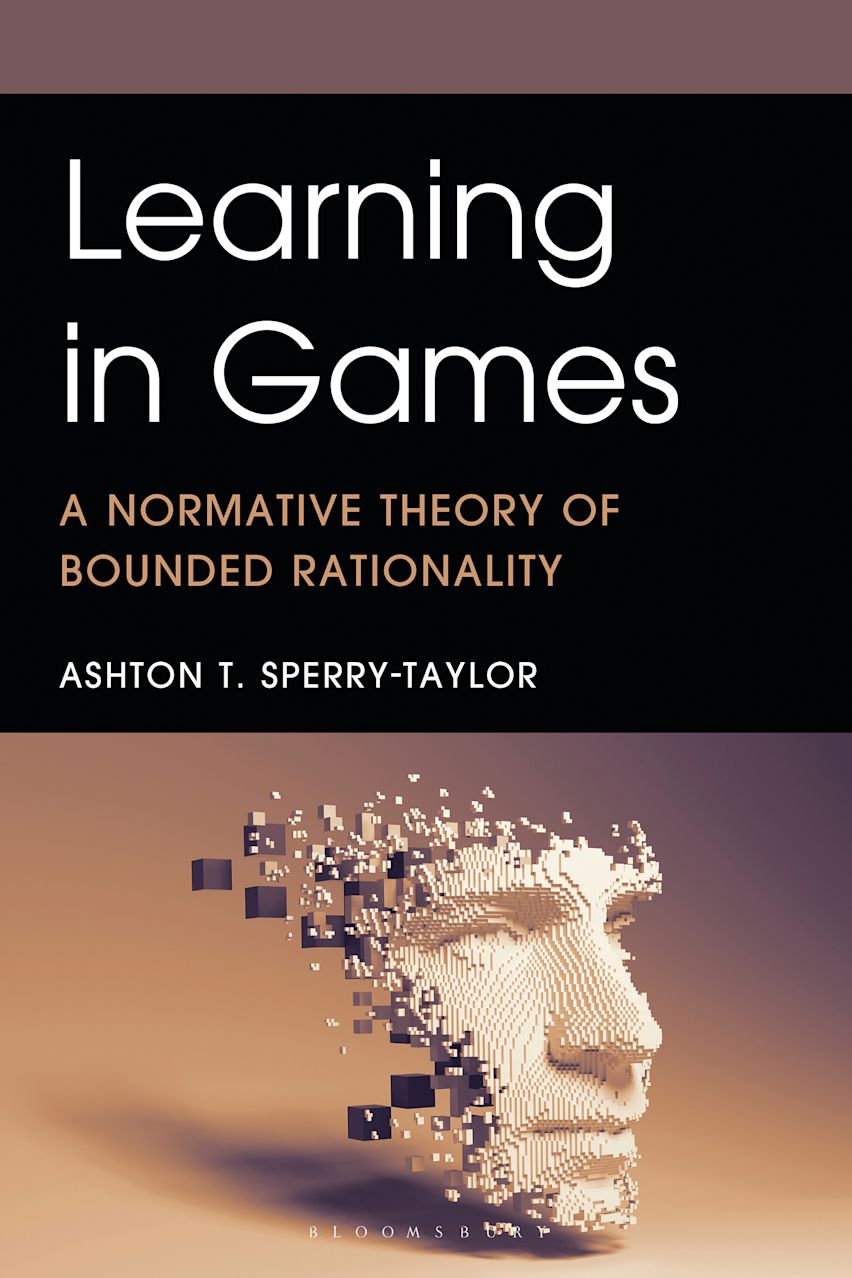
Game theory prescribes strategies based on reasoning that is often beyond the reach of bounded players. This book identifies when they can learn their way to equilibrium-and when they cannot.
Game theory traditionally assumes that players have no cognitive limits and fully know their strategic circumstances. Without those assumptions, equilibrium reasoning no longer guides their decisions. Existing approaches to bounded rationality-ecological rationality, epistemic game theory, evolutionary models, the learning-in-games tradition, and procedural rationality-offer no unified account of how players should learn in uncertain, changing environments or when learning converges to equilibrium.
Ashton T. Sperry-Taylor introduces strategic bandits, which model an opponent using a memory-m rule: the opponent's next move depends on the preceding m rounds. Decision policies have precise convergence conditions. Action-level learning succeeds when players identify the best fixed action and when conditional responses offer no additional value. At the strategic boundary, a conditional policy outperforms every fixed action, even when players learn the best one. At the estimation boundary, the learning process prevents players from identifying that best fixed action.
Sperry-Taylor develops his account through five games: the prisoner's dilemma, the centipede game, the stag hunt, divide the cake, and the battle of the sexes. Across them, bounded players learn their way to equilibrium, fail to coordinate because their payoff estimates mislead them, or learn more slowly to protect against an unpredictable opponent. He distinguishes between difficulties arising from the strategic situation and those arising from the learning process itself.
Accessibility Information
Additional accessibility information
- EPUB 3.0
- Conforms with the requirements of EPUB Accessibility Spec v1.1
- WCAG level AA
- WCAG v2.2 compliant
- accessibility@bloomsbury.com
Hazards
The publication contains no hazards
Support for non-visual reading
- No accessibility features offered by the reading system, device or reading software are disabled or otherwise unusable with the product
- Has alternative text descriptions for images
Visual adjustments
Appearance of the text and page layout can be modified according to the capabilities of the reading system (font family and size, spaces, as well as color of background and text)
Navigation
- Page list to go to pages from the print source version
- Elements such as headings, tables, etc for structured navigation
- All or substantially all textual matter is arranged in a single logical reading order
- Content is enhanced with ARIA roles to optimize organization and facilitate navigation
- Purposes of all links are made clear
Rich content
Language tagging provided
Table of Contents
Chapter 1: Bounded Rationality and Learning in Games
Chapter 2: The Epistemic Relaxation Model
Chapter 3: Foundations of Reinforcement Learning and Stochastic Games
Chapter 4: Explanatory Underdetermination in Sequential Games
Chapter 5: Strategic Bandits and Learning in Games
Chapter 6: The Prisoner's Dilemma-Analytical Results
Chapter 7: The Prisoner's Dilemma-Empirical Results
Chapter 8: The Centipede Game-Analytical Results
Chapter 9: The Quasi-Centipede Game-Empirical Results
Chapter 10: The Stag Hunt-Analytical Results
Chapter 11: The Stag Hunt-Empirical Results
Chapter 12: Divide the Cake-Analytical Results
Chapter 13: Divide the Cake-Empirical Results
Chapter 14: Battle of the Sexes-Analytical Results
Chapter 15: Battle of the Sexes-Empirical Results
Appendix to Chapter 5: Technical Proofs and Finite-State Analysis
Appendix to Chapter 8: Technical Proofs for the Quasi-Centipede
References
Index
Product details

| Published | 04 Mar 2027 |
|---|---|
| Format | Ebook (Epub & Mobi) |
| Edition | 1st |
| Pages | 256 |
| ISBN | 9781978764439 |
| Imprint | Bloomsbury Academic |
| Publisher | Bloomsbury Publishing |
Related Titles