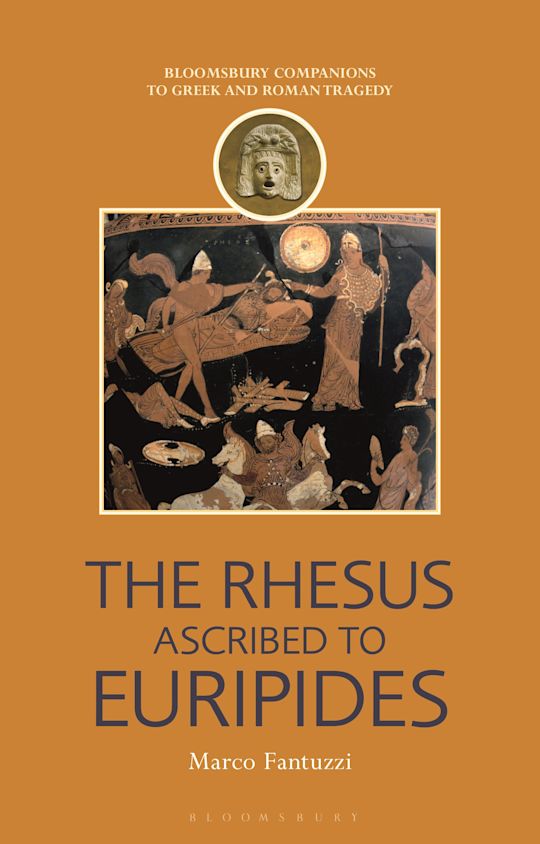


The Rhesus Ascribed to Euripides
Description
The Rhesus came down to us among the plays of Euripides, and was acknowledged as Euripidean by Aristotle. However, there is much debate as to its authorship and it may have been the work of a rival dramatist or 4th-century actors who heavily re-worked or interpolated Euripides' original play with this title.
This is the first accessible introduction to the play, analysing its themes, performance and context for students of Euripides and other Greek drama. The Rhesus provides invaluable evidence about 4th-century production and performance of tragedy, which is otherwise known only from very few and short fragments from other lost plays. Stylistic and historical analysis together show what being a "post-classical" tragedy could mean – the play's composition probably took place precisely in the age when the canon of the three great tragedians was instituted and the plays of Aeschylus, Sophocles, and Euripides became the incomparable "classical" texts of tragedy.
The Rhesus is a splendid example of what "coming after" can mean for literary works: it is situated after, and thus reflects, both Homer and also canonical 5th-century tragedy. Little is written about 4th-century poetry, although its relevance in the incubation of Hellenistic poetry is a topos of literary and historical studies. By putting the Rhesus more solidly on the chronological map, stylistic and historical analysis proves that it can shed light on this tantalizing age.
Accessibility Information
Additional accessibility information
- PDF/UA-2, 1.4
- accessibility@bloomsbury.com
Hazards
The publication contains no hazards
Support for non-visual reading
Has alternative text descriptions for images
Navigation
- Page list to go to pages from the print source version
- Elements such as headings, tables, etc for structured navigation
- All or substantially all textual matter is arranged in a single logical reading order
Table of Contents
Chapter 1: RHESUS, A MYTHOLOGIC CHARACTER ALMOST WITHOUT MYTHS
Chapter 2: CHARACTERS AND ACTION, AND THE RED FLAGS OF POETIC NOVELTIES
Chapter 3: ANCIENTS AND MODERNS ON THE LITERARY QUALITY OF RHESUS
Chapter 4: PICTORIAL AND HISTORICAL SYNCHRONISMS FAVOURING A 4th-CENTURY RHESUS
Notes
Bibliography
Index
Product details

| Published | 13 May 2027 |
|---|---|
| Format | Ebook (PDF) |
| Edition | 1st |
| Pages | 224 |
| ISBN | 9781350004023 |
| Imprint | Bloomsbury Academic |
| Illustrations | 7 bw illus |
| Series | Companions to Greek and Roman Tragedy |
| Publisher | Bloomsbury Publishing |
Related Titles