- Home
- ACADEMIC
- Education
- Higher Education
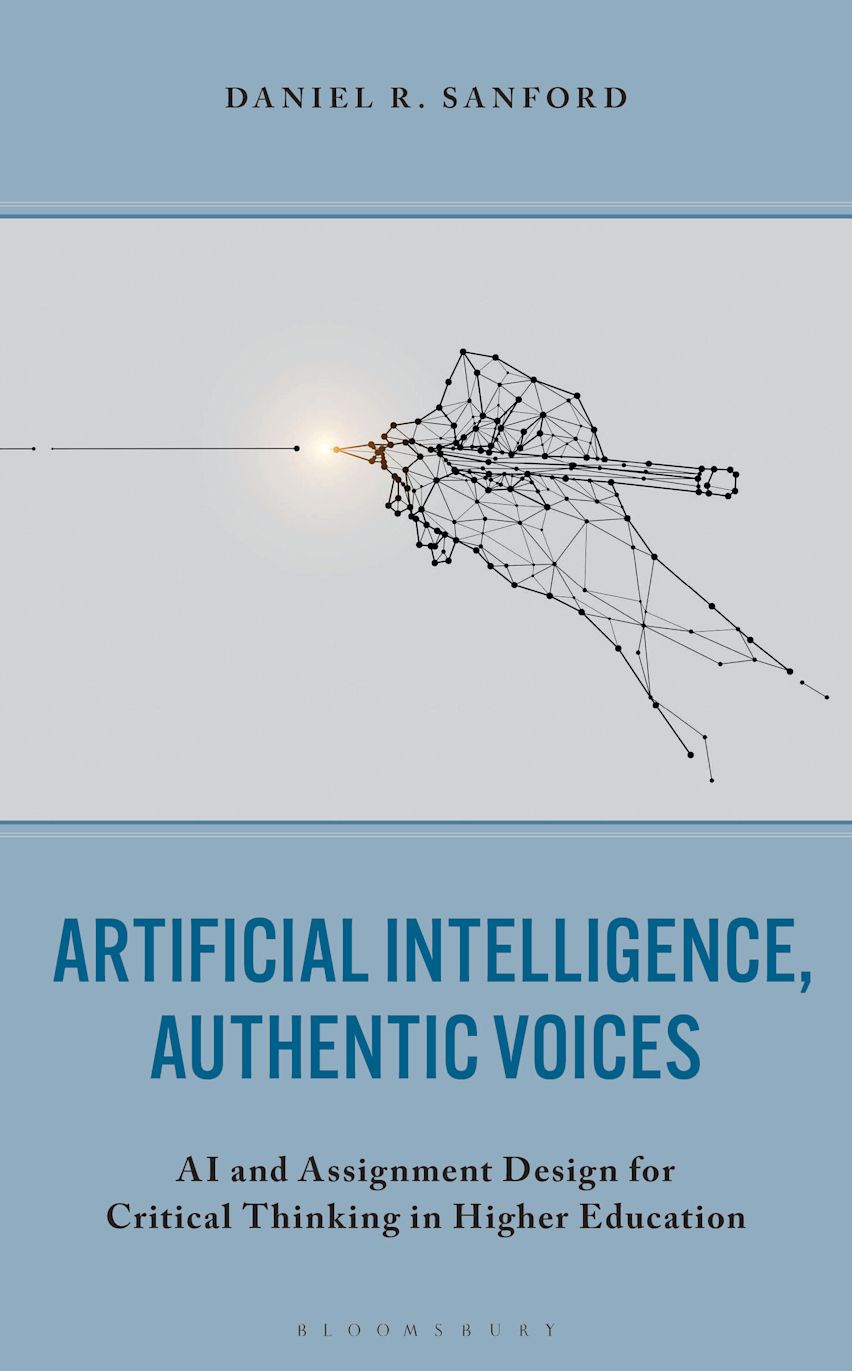
- Artificial Intelligence, Authentic Voices
Artificial Intelligence, Authentic Voices
AI and Assignment Design for Critical Thinking in Higher Education
Artificial Intelligence, Authentic Voices
AI and Assignment Design for Critical Thinking in Higher Education

Buying pre-order items
Ebooks and Audiobook
You will receive an email with a download link for the ebook or audiobook on the publication date.
Payment
You will not be charged for pre-ordered books until they are available to be shipped. Pre-ordered ebooks will not be charged for until they are available for download.
Amending or cancelling your order
For orders that have not been shipped you can usually make changes to pre-orders up to 72 hours before the publishing date.
Payment for this pre-order will be taken when the item becomes available
- Delivery and returns info
-
Free UK delivery on orders £30 or over
You must sign in to add this item to your wishlist. Please sign in or create an account
Description
When generative AI can produce polished academic work in seconds, what does student work actually tell us about learning? Rather than focusing on AI tools, detection systems, or platform comparisons, this book examines how assignment design can make learning visible under changing technological conditions.
Drawing on research in learning, assessment, and faculty development, Daniel R. Sanford argues that the central challenge posed by AI is not simply academic integrity, but the growing difficulty of using finished products as evidence of learning. When production can be automated, assignments must be designed to surface judgment, decision-making, revision, interpretation, and critical thinking.
Organized around durable cognitive practices such as reflection, analysis, argumentation, collaboration, ethics, and metacognition, this book offers practical strategies for redesigning assignments across disciplines and teaching modalities. It will help faculty make student thinking visible, cultivate authentic voice, and reconnect student work to the learning it is meant to represent.
Table of Contents
Introduction: The Stakes of Assignment Design in the Age of AI
Part I. Durable Skills for Individual Thinking
Chapter 1. Reflection
Chapter 2. Structure
Chapter 3. Analysis and Interpretation
Chapter 4. Argument and Evidence
Chapter 5. Revision and Iteration
Part II. Durable Skills for Social and Communal Thinking
Chapter 6. Conversation
Chapter 7. Collaboration
Chapter 8. Ethics
Chapter 9. Metacognition
Chapter 10. Futures
Conclusion: Preserving Human Thinking
Product details

| Published | 04 Mar 2027 |
|---|---|
| Format | Paperback |
| Edition | 1st |
| Pages | 224 |
| ISBN | 9798216467038 |
| Imprint | Bloomsbury Academic |
| Illustrations | 22 textboxes |
| Dimensions | 229 x 152 mm |
| Publisher | Bloomsbury Publishing |
About the contributors
Reviews
-
This is a wonderful and much-needed book on how to make learning visible again. Sanford carefully categorizes the things we really want to understand about student thinking (like reflection, analysis and argumentation) and then briefly diagnoses how we might redesign their assessment after AI has undermined so many of our old methods. He pushes past trying to detect if students did 'work' to present truly innovative new assignment designs that assess how students are considering decisions and making judgments. Clear examples of each new assignment design from a wide variety of disciplines increase in complexity as the book progresses. With clear insight and many practical solutions, this really is a book for everyone who cares about rebuilding real learning in the age of AI.
José Antonio Bowen, Ph.D., FRSA Senior Fellow, American Association of Colleges and Universities (AAC&U), author of '"Teaching with AI" and "Teaching Naked"
-
Authenticating Intelligence offers a historically and philosophically-grounded examination of what generative AI means for education-cutting through both hype and panic to focus on what truly matters in the here-and-now for human learning. Written very accessibly but well supported by both recent and classic scholarship, this book is valuable for educators and other thinkers who have fundamental questions about the role of AI in the educational system.
Victor R. Lee, Associate Professor, Stanford University, Graduate School of Education
-
Dr. Stephen J. Aguilar's Authenticating Intelligence is essential reading for anyone committed to learner-centered, equitable education in the age of AI. Aligned to Digital Promise's Powerful Learning framework, this book demonstrates how generative AI can amplify-rather than replace-the competencies that matter most: critical thinking, creative problem-solving, and authentic intellectual engagement. Aguilar masterfully bridges scholarship across philosophy, psychology, and educational technology to address our most pressing challenge: designing learning experiences where AI serves as a thinking partner that deepens understanding rather than a shortcut that bypasses it. His work on digital equity and academic integrity pushes us beyond surface solutions toward fundamentally rethinking what authentic learning means when machines can generate flawless outputs. Whether you're an educator, policymaker, or researcher, this book provides the ethical frameworks and actionable guidance needed to ensure AI enhances human agency and the pursuit of knowledge itself-the very foundations of powerful learning in our digital age.
Jean-Claude Brizard, President and CEO, Digital Promise Global
-
Dr. Aguilar cuts through the noise and hype around AI to help educators, technologists, and anyone interested in education focus on the essential questions that ensure responsible and effective use of AI tools. Grounded in philosophy and research yet highly accessible, the book centers on the practical goal of improving learning for all students amid profound shifts in how we interact with AI. It's a vital read for education leaders, technologists, parents, teachers, and students alike.
Dr. June Ahn, Professor and Senior Associate Dean, University of California, Irvine, School of Education
-
Reading Authenticating Intelligence means having a conversation with Stephen about how to think about AI. Stephen has a way of providing examples and framing questions that strips away the hyperbole and hysteria and presents a pragmatic lens for understanding and envisioning what the ubiquity of AI could mean for education. He stresses how, as a tool (or rather many different tools), the degree to which AI disrupts our approach to learning is dependent on much more than the tools themselves. Instead, like all the educational technology “disruptors" that have come before, it is foremost about people and context and how they interact with the technology. Everyone, whether in higher education, K-12 education, or the corporate world – is scrambling to understand what AI means, and what policies and practices are necessary as its application expands. Authenticating Intelligence equips the reader with a toolkit for critically examining and discussing both future possibilities and current practices – a perspective that will continue to serve even as the technology inevitably changes.
Dr. William R. Watson, Professor of Learning Design and Technology, Chair of the College of Education's AI and Data Science Working Group, Purdue University