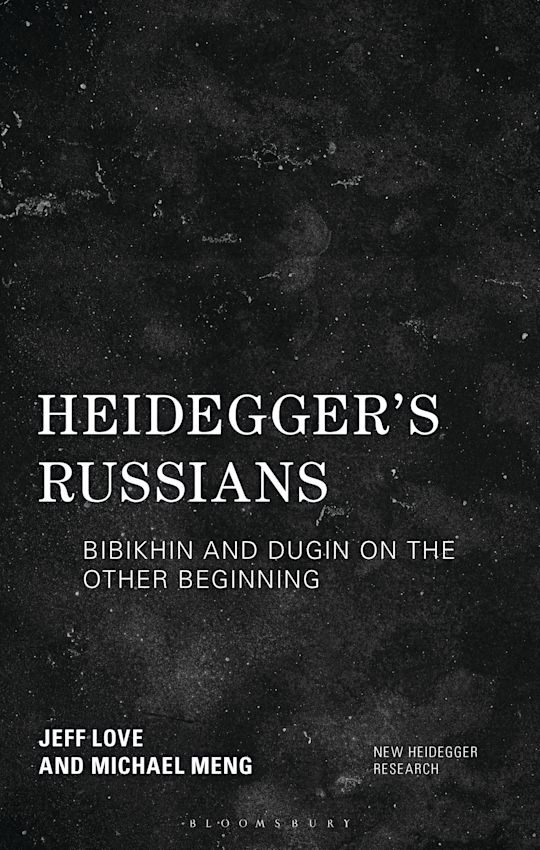
Heidegger's Russians
Bibikhin and Dugin on the Other Beginning

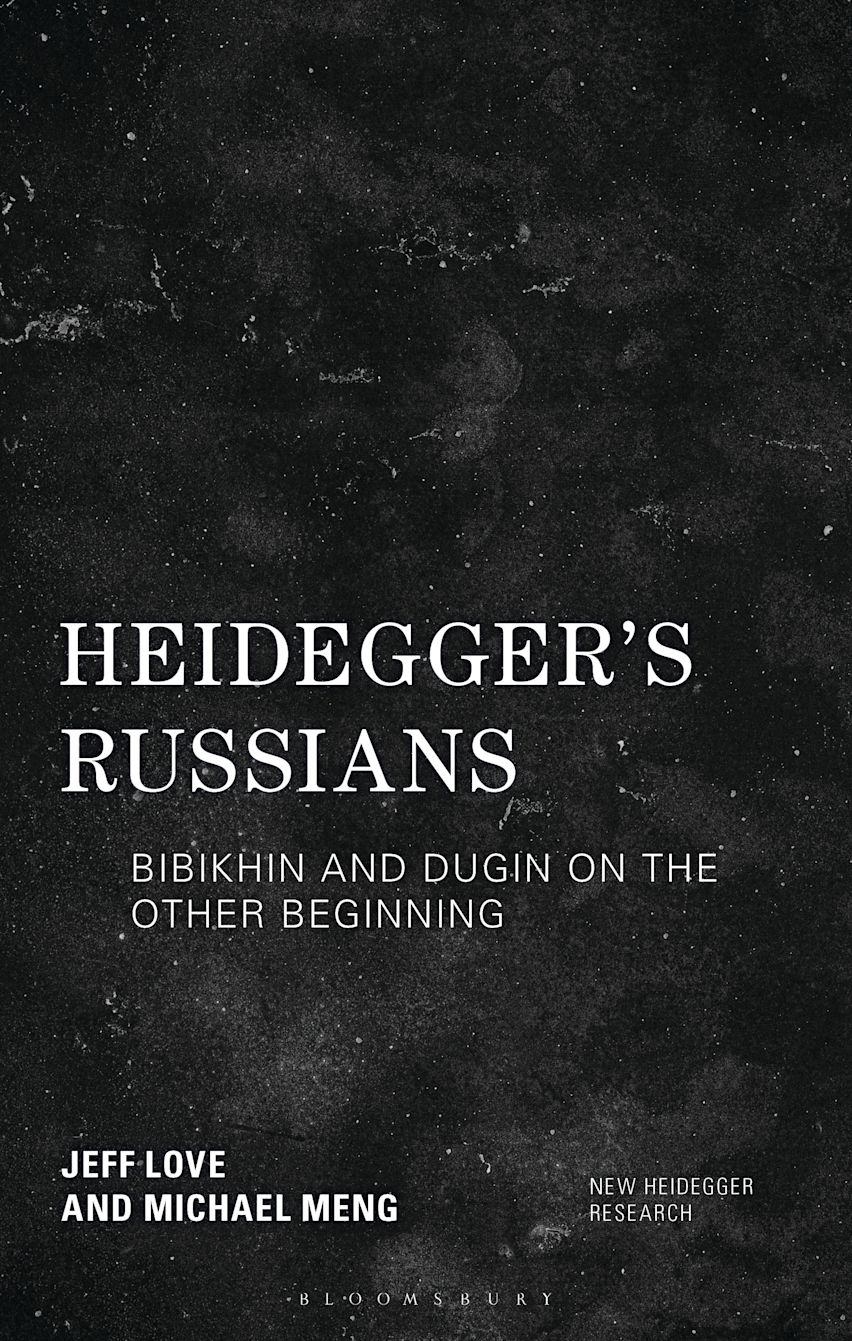
Heidegger's Russians
Bibikhin and Dugin on the Other Beginning
Buying pre-order items
Ebooks and Audiobook
You will receive an email with a download link for the ebook or audiobook on the publication date.
Payment
You will not be charged for pre-ordered books until they are available to be shipped. Pre-ordered ebooks will not be charged for until they are available for download.
Amending or cancelling your order
For orders that have not been shipped you can usually make changes to pre-orders up to 72 hours before the publishing date.
Payment for this pre-order will be taken when the item becomes available
- Delivery and returns info
-
Free UK delivery on orders £30 or over
Description
This book gives a philosophical account of Martin Heidegger's influence on two important and hitherto understudied Russian philosophers, Aleksandr Dugin (b. 1962 -) and Vladimir Bibikhin (1938 - 2004).
The book focuses on Heidegger's thought as revolutionary and in search of bringing about an other beginning in philosophy and politics. Dugin and Bibikhin are examples of Russian thinkers inspired by Heidegger to consider revolutionary alternatives in the creation of a new beginning for Russia in the wake of the collapse of the Soviet Union in 1991. Dugin represents an attempt to assert the sovereign identity and destiny of Russia and Russian thought as against modern liberal thinking, inspired by the Enlightenment and embodied in the hegemony of the United States, the “unipolar tyrant” threatening to impose its domination on the world. Bibikhin envisages a different assertion of Russian identity that does not seek direct confrontation with other nations but a transformation in how we may think the political and the destiny of humanity in the modern technological age. If Dugin advocates struggle and a philosophy of chaos that is distinctively Russian in his view, Bibikhin advocates a coming to terms with our brief existence by taking on the burden of mortality, in his words, the “burden of the cross.” If Dugin advocates recognition of the negative and nothingness, Bibikhin advocates plenitude, a fullness that cannot be exhausted. These Russian thinkers take up major aspects of Heidegger's philosophical work; they adapt them in intriguing ways to an extreme existential and political situation whose consequences are still very relevant to the present day, both in terms of Russia's influence on the world stage and on the growing turn to the political right that is an international phenomenon of considerable importance.
Table of Contents
1. The Violence-Doer
2. Political Detours?
3. In Search of Russian Philosophy
4. The Last God
5. An Other Way
6. Is Transition Still Possible?
Bibliography
Index
Product details

| Published | 27 May 2027 |
|---|---|
| Format | Paperback |
| Edition | 1st |
| Pages | 190 |
| ISBN | 9798216275367 |
| Imprint | Bloomsbury Academic |
| Dimensions | 229 x 152 mm |
| Series | New Heidegger Research |
| Publisher | Bloomsbury Publishing |
Reviews

ONLINE RESOURCES
Bloomsbury Collections
This book is available on Bloomsbury Collections where your library has access.
Related Titles