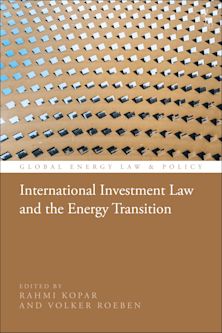
International Arbitration and the Energy Transition
Shifting Foundations for Investment Law



International Arbitration and the Energy Transition
Shifting Foundations for Investment Law
Buying pre-order items
Ebooks and Audiobook
You will receive an email with a download link for the ebook or audiobook on the publication date.
Payment
You will not be charged for pre-ordered books until they are available to be shipped. Pre-ordered ebooks will not be charged for until they are available for download.
Amending or cancelling your order
For orders that have not been shipped you can usually make changes to pre-orders up to 72 hours before the publishing date.
Payment for this pre-order will be taken when the item becomes available
Description
This book offers a broad definition of the energy transition, going beyond its climate origins to include energy security, affordability concerns and the impacts of the digital economy.
It explores the multiplication of disputes triggered by policies of phasing in and phasing out certain forms of energies, and how international arbitration has responded to this exponential increase in disputes among investors, states, and civil society.
Investments in this sector tend to be large and long-term, but international law protections have been weakened by many states. The book reviews the new landscape of investor protections in treaties and long-term contracts.
The book explores the changing role of the State in setting the rules for investment, as new forms of infrastructure are deemed 'critical' or 'strategic', in the context of growing international competition, and vulnerability of global supply chains. Uncertainty about the scope and timing of interventions requires a shift in the current international investment law regime if investments are to mobilize to drive forward the energy transition.
The preferred mode of resolving disputes – both contract and treaty based - remains international arbitration. The book critically reviews the many changes introduced by international and regional arbitration centres to improve the operation of this key mechanism.
The approach of this book is twofold: it examines energy disputes in each energy sector (Part 2) and by means of an analysis of seminal, highly controversial cases it examines how international arbitration has addressed the energy transition to date.
This is a key resource to understand how the energy transition is impacting on the resolution of disputes, procedurally as well as substantively in the face of geopolitical headwinds and the growing impact of the digital economy.
Accessibility Information
Additional accessibility information
- PDF/UA-2, 1.4
- accessibility@bloomsbury.com
Hazards
The publication contains no hazards
Support for non-visual reading
Has alternative text descriptions for images
Navigation
- Page list to go to pages from the print source version
- Elements such as headings, tables, etc for structured navigation
- All or substantially all textual matter is arranged in a single logical reading order
Table of Contents
1. The Energy Transition as a Catalyst for Disputes
2. Investment and the Flexibility of International Arbitration
3. The Approach taken in this Book
Part 2: Where and How Dispute Emerge – The Energy Transition by Sector
4. Renewable Energy Disputes
5. Gas Supply and Pricing Disputes
6. Infrastructure: Grids, Pipelines and Data Centres
7. The Supply Chain: Critical Minerals
8. Nuclear Energy
9. Oil Contracting
10. New Technologies, New Interfaces
Part 3: Flexibility Versus Stability: The Legal Response
11. Commercial Contracting: Force Majeure, Limitation of Liability
12. The Right to Regulate
13. Fair and Equitable Treatment vs. Contract Stability
Part 4: A Way Forward
14. Shifting Foundations in International Investment Law
Product details
| Published | 29 Apr 2027 |
|---|---|
| Format | Ebook (PDF) |
| Edition | 1st |
| Pages | 320 |
| ISBN | 9781509984046 |
| Imprint | Hart Publishing |
| Series | Global Energy Law and Policy |
| Publisher | Bloomsbury Publishing |

Related Titles