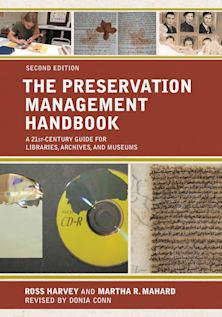
The Preservation Management Handbook
A 21st-Century Guide for Libraries, Archives, and Museums
- Textbook

The Preservation Management Handbook
A 21st-Century Guide for Libraries, Archives, and Museums
- Textbook
Please note that this product is not available for purchase from Bloomsbury websites.
Description
Cultural heritage professionals – museum curators, museum professionals, archivists and librarians – work with their specialized knowledge to prioritize the needs of their collections. Preservation managers draw on experts in climate control, fire safety, pest management and more in developing the large overview of a collection and its needs. And all the special materials within the collections have their experts too.
Here, in one volume, is a wide range of topic-specific expertise that comprises both an enduring text for preservation students as well as an essential one-stop reference for cultural heritage professionals—particularly those in small- to medium sized organizations where resources are limited and professional help is not always at hand.
The editors introduce the reader to the essential tools and principles of a preservation management program in the twenty-first century, addressing the realities of diverse collections and materials, and embracing the challenges of working with both analog and digital collections.
The sections on planning and managing a preservation program contain the basic starting point for any kind of collection, regardless of size and content. Written with the small collection in mind, the principles are nevertheless scalable and widely applicable.
Table of Contents
Foreword by Michele V. Cloonan
Preface
Acknowledgments
PART I: FUNDAMENTALS
Chapter 1: Mapping the Preservation Landscape for the Twenty-first Century
Fundamental Change
Definitions
Hybrid Collections
New Skills
Conclusion
Chapter 2: Preservation Principles
Preservation Principles
Context and Aims
General Principles
Specific Principles
Artifact or Information?
Starting Points
Chapter 3: Managing Preservation: Policy, Assessment, Planning
Preservation as Institutional MandateMission Statements
Sample Mission Statements
Developing a Mission Statement
Policies
Sample Preservation Policies
Practical Considerations
Related PoliciesAssessment: Building, Context, Environment
Conducting the AssessmentExternal Risk Factors
Assessment: Collection ConditionDetermining What is in the Collection
Survey ToolsReviewing Storage Conditions
Determining Value Developing a PlanBuilding a Realistic and Supportable Plan
Staff
Staff TrainingDisaster Planning and RecoveryMinimizing Risks
Response
Recovery
Developing a Disaster Plan
Conclusion
PART II: COLLECTIONS
Chapter 4: Artifacts and Information
Concepts
Information or Artifact?
Access Requirements and Preservation
Preserving Artifacts
Intrinsic Characteristics
Paper Manufacture and Quality
Putting the Image onto paper
Book Structure
Other Materials in Paper-based Collections
Extrinsic Factors
Storage Environment
Enclosures
Shelving
Handling
Standards
Routine Collection Maintenance
Preserving Information
Reformatting Physical Objects
Target Formats
Digital Objects
Microfilm
Preservation Photocopies
Other Formats
Reformatting Digital Objects
Conclusion
Chapter 5: The Environment
Common Practices
Risk Management
Agents of Deterioration
Monitoring
The Ideal Environment
Building Envelope and Structure
Impact of Local Climate
Human Comfort
Design and Construction of Buildings
Cost
Renovating an Existing Building
New Buildings
Integrated Pest Management
Trusted Digital Repositories
Definition of a TDR
Principles of TDRs
Auditing and Certification
Principles and Best Practices
Heat
Water
Light
Air
Mold
Pests
Fire
Conclusion
PART III: MATERIALS AND OBJECTS
Chapter 6: Creating Preservation-friendly Objects
Rationale
Contexts and Materials
Responsibilities
Intellectual Access and Control
Kinds of Metadata
Describing Objects
Indicating Relationships Among Objects
Recording the History of Objects
Managing and Using Objects
Representation Information
Other Metadata Considerations
Creating Preservation-friendly Objects: Examples
Medieval Scribes' Choice of Material
Charles Darwin's Notebooks
Library Editions
Microfilm
Permanent Paper
Film
Long-lived Digital Storage Media
Digital Objects Created from Digitizing
Born-digital Objects
Conclusion
PART IV: MEDIA AND MATERIAL
Introduction
Chapter 7: Holdings Protection (Richard Dine, Michael F. Knight, Shelby Sanett)
Chapter 8: Paper Objects and Books
Paper: Library and Archives Materials (Donia Conn)
Paper: Works of Art on Paper (Donia Conn)
Books (Dawn Walus)
Chapter 9: Photographic Materials
Photographic Materials (Brenda Bernier)
Microform (Ross Harvey)
Chapter 10: Sound Materials
Sound Materials: Magnetic Media (Elizabeth Walters)
Sound Materials: Mechanical Formats (Bob Pymm)
Sound Materials: Compact Discs (Matthew Davies)
Chapter 11: Moving Image Materials
Moving Image Materials: Motion Picture Film (Liz Coffey)
Moving Image Materials: Magnetic Media (Elizabeth Walters)
Chapter 12: Digital Storage Media and Files
Digital Storage Media: Magnetic Formats (Leslie Johnston)
Digital Storage Media: Optical and Magneto-optical Formats (Leslie Johnston)
Digital Storage Media: Flash Storage (Leslie Johnston)
Digital Files (Ross Harvey)
Chapter 13: Textiles (Frances Lennard)
Chapter 14: Paintings (Heather Hole)
Contributors
Bibliography
Standards
Index
Product details
| Published | 10 Apr 2014 |
|---|---|
| Format | Ebook (Epub & Mobi) |
| Edition | 1st |
| Pages | 400 |
| ISBN | 9780759123168 |
| Imprint | Rowman & Littlefield Publishers |
| Publisher | Bloomsbury Publishing |
Reviews
Related Titles