Antinomies of Family Justice
Accommodating Dichotomies



Antinomies of Family Justice
Accommodating Dichotomies
Buying pre-order items
Ebooks and Audiobook
You will receive an email with a download link for the ebook or audiobook on the publication date.
Payment
You will not be charged for pre-ordered books until they are available to be shipped. Pre-ordered ebooks will not be charged for until they are available for download.
Amending or cancelling your order
For orders that have not been shipped you can usually make changes to pre-orders up to 72 hours before the publishing date.
Payment for this pre-order will be taken when the item becomes available
- Delivery and returns info
-
Free US delivery on orders $35 or over
Description
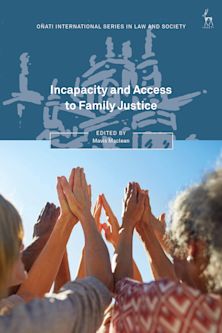
This book examines the changing role of law in resolving family disputes by investigating the contradictory directions of family justice reform.
Family Law sets up a number of dichotomies, including between public/private, vulnerability/autonomy and law/non-law. While these dichotomies are useful for law, are sometimes real and often antinomic, there are also circumstances in which they blur into each other and where the boundaries between them shift. The shifting boundaries are the product of the redefinition and reconstruction of categories such that public/private becomes court/non-court and law/non-law becomes justice/therapy, and blurring occurs between public and private and between autonomy and vulnerability.
We see these processes of redefinition and resetting of boundaries as linked and as illustrations of the ways in which the FJS (Family Justice Service) rationalises removing more and more family disputes from the realm of law. The FJS seems by these changes to be less about traditional ideas of justice as disputes are being hived off to processes that are not transparent, not accountable and normatively diffuse. As the category of non-law/NCDR expands while becoming more firmly embedded with the Family Justice System, we see also an implicit redefinition of justice and we question the effect this redefinition has for weaker parties, most often women and children.
Table of Contents
2. Antinomies in the Family Justice System: Public/Private, Law/Non-Law; Vulnerability/Autonomy
3. Non-Court 'Solutions'
4. Autonomy, Privacy and Non-law: Non-Court Dispute Resolution
5. The Public: Court-Based Dispute Resolution
6. Justice, Vulnerability and Family Courts
7. Concluding Thoughts
Product details
| Published | May 13 2027 |
|---|---|
| Format | Hardback |
| Edition | 1st |
| Pages | 272 |
| ISBN | 9781509974887 |
| Imprint | Hart Publishing |
| Dimensions | 9 x 6 inches |
| Publisher | Bloomsbury Publishing |
Related Titles