

Buying pre-order items
Ebooks and Audiobook
You will receive an email with a download link for the ebook or audiobook on the publication date.
Payment
You will not be charged for pre-ordered books until they are available to be shipped. Pre-ordered ebooks will not be charged for until they are available for download.
Amending or cancelling your order
For orders that have not been shipped you can usually make changes to pre-orders up to 72 hours before the publishing date.
Payment for this pre-order will be taken when the item becomes available
- Delivery and returns info
-
Free US delivery on orders $35 or over
Description
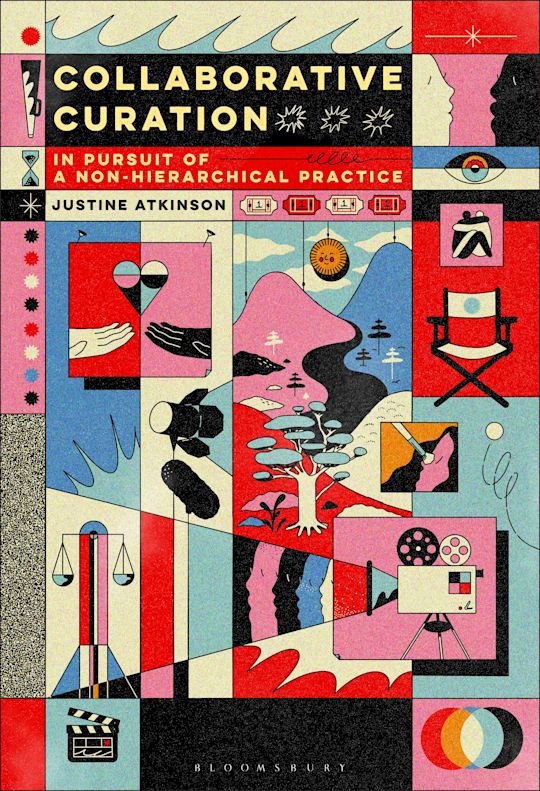
This is the first exploration of the model of collaborative curation, a non-hierarchical decision-making process that requires a decentering of the individual, to reimagine curatorial practice in film from both individual and institutional perspectives.
This book questions the individualized curatorial process within film exhibition and the limitations surrounding centering the individual gaze, as each time the curator undertakes the process of valuing and selecting films, their positionality and particular lens informs the value they place on films. This can be both a conscious and unconscious process; nevertheless it is crucial to hold an awareness of this subjectivity in film selection. This book proposes the model of collaborative curation to move towards more collective forms of curatorial practice. It demonstrates how singular curators cannot be expected to represent communities; therefore, a considered, collectivized approach can work to ensure greater on and off-screen representations. It is a process of care, which works to dismantle hierarchies to create renewed re-imaginings within film institutions. Collaborative curation is proposed on individual and structural levels as a process of decoloniality by virtue of the shifts in power and knowledge systems and transition to collective forms of organizing.
The book looks at three case studies: the Africa in Motion (AiM) Film Festival, which provides an example of using collaborative curation within a festival; Aya Films, looking at distribution as a form of curation; and the role traineeships play in the UK film exhibition workforce, drawing on the examples of offline and online training platforms: The New Promoter Scheme and Curate-It.
Table of Contents
1. Reimagining Institutions Through a Decolonial Lens
2. Questioning Power? The Fragmented Processes of Decolonizing Curatorial Practice
3. Representation Matters: The Convergent Elements of Curatorial Practices in Film Distribution
4. Curatorial Equity in the Digital Age? An Assessment of Curatorial Training On and Offline
Conclusion
References
Index
Product details

| Published | Jan 21 2027 |
|---|---|
| Format | Hardback |
| Edition | 1st |
| Pages | 216 |
| ISBN | 9798765127872 |
| Imprint | Bloomsbury Academic |
| Illustrations | 3 bw illus |
| Dimensions | 9 x 6 inches |
| Publisher | Bloomsbury Publishing |
Reviews
Related Titles