Conscripting Civilians
Communist Travel Administration in the Cold War
- Open Access
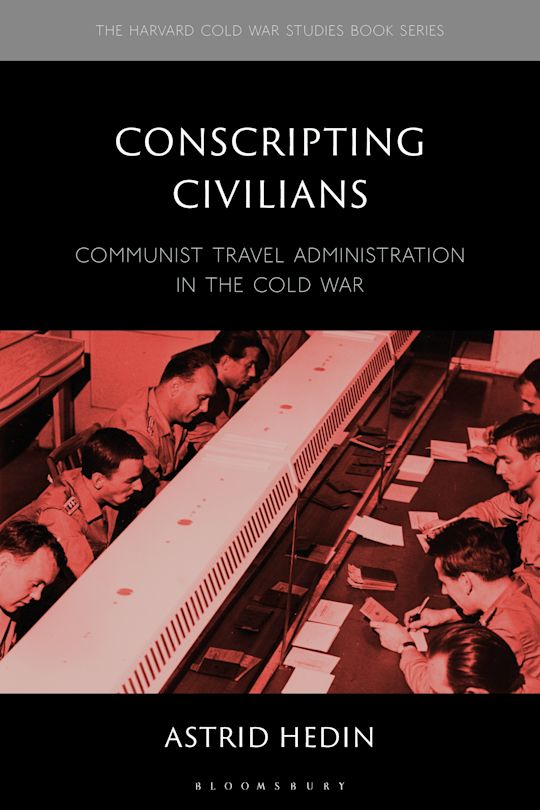


Conscripting Civilians
Communist Travel Administration in the Cold War
- Open Access
Buying pre-order items
Ebooks and Audiobook
You will receive an email with a download link for the ebook or audiobook on the publication date.
Payment
You will not be charged for pre-ordered books until they are available to be shipped. Pre-ordered ebooks will not be charged for until they are available for download.
Amending or cancelling your order
For orders that have not been shipped you can usually make changes to pre-orders up to 72 hours before the publishing date.
Payment for this pre-order will be taken when the item becomes available
- Delivery and returns info
-
Free US delivery on orders $35 or over
Description
Why did communist states build elaborate procedures to control who could travel to the West? This open access book argues that travel administration was designed not merely for surveillance, but as an instrument of political warfare, broadly conceived.
Under classified travel regulations, even routine travel by state-sector employees served broader foreign-policy goals. All travelers were to be covertly vetted for political reliability, individually instructed to represent the state, and debriefed upon their return.
Conscripting Civilians argues that travel administration effectively conscripted academics, doctors, engineers, and other professionals into the Cold War struggle over narratives, sympathies, and political identities. Examples from East German university contacts with Sweden illustrate how this broader system operated in practice.
Drawing on state and Stasi records, the book maps the architecture of state-sector travel administration, showing that the system constituted a distinct and largely hidden form of state capacity. Designed not only to defend the socialist state but also to influence the West, it shaped the conditions for transnational dialogue and enlisted travelers to advance state objectives within international organizations, professional associations, and Western societies.
The ebook editions of this book are available open access under a CC BY-NC-ND 4.0 licence on bloomsburycollections.com. Open access was funded by Riksbankens Jubileumsfond.
Table of Contents
List of Figures
List of Tables
1. Introduction
2. How the State Made Political War: Travelers in Action
3. How War Made the State: The Historical Development of the Travel Cadre System
4. Conscripting Travelers: Workplace Managers in the Leninist Web
5. Deploying Travelers: The Workplace Travel Office as Command Post
6. Coordinating Travelers: The Sectoral Ministries as Command Centers
7. Debriefing Travelers: Workplace Travel Offices as MfS Switchboards
8. How Communist State Capacity Was Different
9. Conclusions
Appendies
Product details

| Published | Jun 10 2027 |
|---|---|
| Format | Hardback |
| Edition | 1st |
| Pages | 272 |
| ISBN | 9781498594325 |
| Imprint | Bloomsbury Academic |
| Dimensions | 9 x 6 inches |
| Series | The Harvard Cold War Studies Book Series |
| Publisher | Bloomsbury Publishing |
Reviews
Related Titles