Constructing Nietzsche's Politics
Ethical Libertarianism
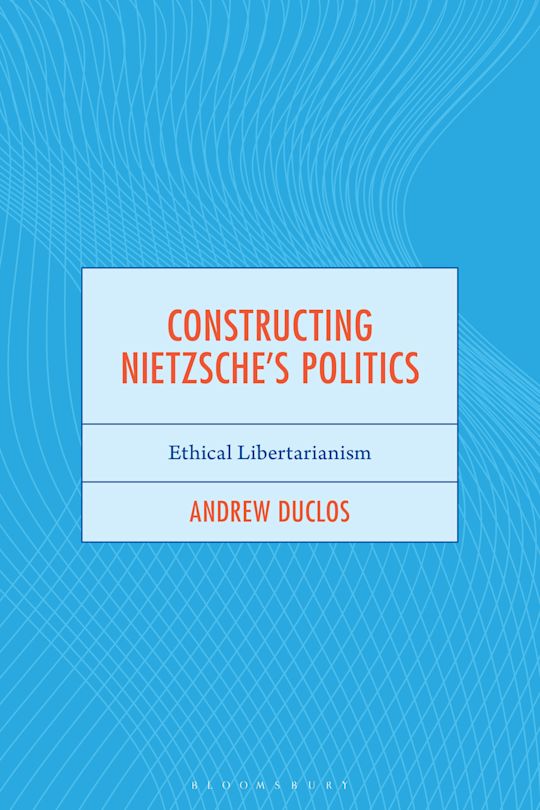


Constructing Nietzsche's Politics
Ethical Libertarianism
Buying pre-order items
Ebooks and Audiobook
You will receive an email with a download link for the ebook or audiobook on the publication date.
Payment
You will not be charged for pre-ordered books until they are available to be shipped. Pre-ordered ebooks will not be charged for until they are available for download.
Amending or cancelling your order
For orders that have not been shipped you can usually make changes to pre-orders up to 72 hours before the publishing date.
Payment for this pre-order will be taken when the item becomes available
- Delivery and returns info
-
Free US delivery on orders $35 or over
Description
A timely new interpretation of Nietzsche's politics which reconciles the apparent contradictions in Nietzsche's texts by defining his politics as “ethical libertarianism.”
Nietzsche's politics has been the subject of much debate, with the existing scholarship largely divided between aristocratic and anti-democratic readings on the one hand, and democratic readings on the other. This book takes its place in the emerging trend of trying to find a “third way” by arguing that Nietzsche's philosophy implies a form of libertarianism. This interpretation emphasizes individual self-transformation and the need to organize society in a way which best facilitates this for its members. While libertarianism is closest to Nietzsche's requirements, it needs to be reformulated to be made fully consistent with his philosophy. This requires a rejection of any grounding of the natural rights of the individual, presumed to be equal for all, in a metaphysical conception of the self. A Nietzschean “ethical libertarianism” would be based on protecting equal access of individuals to conditions which promote self-cultivation. It is thus democratic, but also meritocratic, as rights will be seen to accrue on the basis of individual development.
Table of Contents
Preface
List of Abbreviations
Introduction
Part One: Nietzsche's Ontology
1. Nietzsche's Concept of the Self
2. One's Relation to the Self
3. Becoming and Will to Power
4. Reinterpreting the Will to Power, Becoming, and Nietzsche's Ontology
Part Two: Nietzsche's Ethics
5. The Self as Perspectival and Interpretive
6. The Role of Opposition and Overcoming in the Self
7. Eternal Recurrence and Amor Fati as Interpretive Mechanisms for Overcoming
8. Self-Cultivation and Life-Affirmation
9. Traits for Self-Cultivation
10. Free Spirits
11. The Übermensch
12. The Social Fabric, Culture, and the Individual
13. A Possibility for Anyone
Part Three: Nietzsche's Politics
14. Political Aristocratism
15. Nietzsche contra Democracy in General
16. Democratic Liberalism
17. Democratic Conservatism
18. Ethical Libertarianism
Conclusion: Life-Affirmation
Bibliography
Index
Product details

| Published | Mar 18 2027 |
|---|---|
| Format | Paperback |
| Edition | 1st |
| Pages | 256 |
| ISBN | 9781666938081 |
| Imprint | Bloomsbury Academic |
| Dimensions | 9 x 6 inches |
| Series | Continental Philosophy and the History of Thought |
| Publisher | Bloomsbury Publishing |

ONLINE RESOURCES
Bloomsbury Collections
This book is available on Bloomsbury Collections where your library has access.
Related Titles