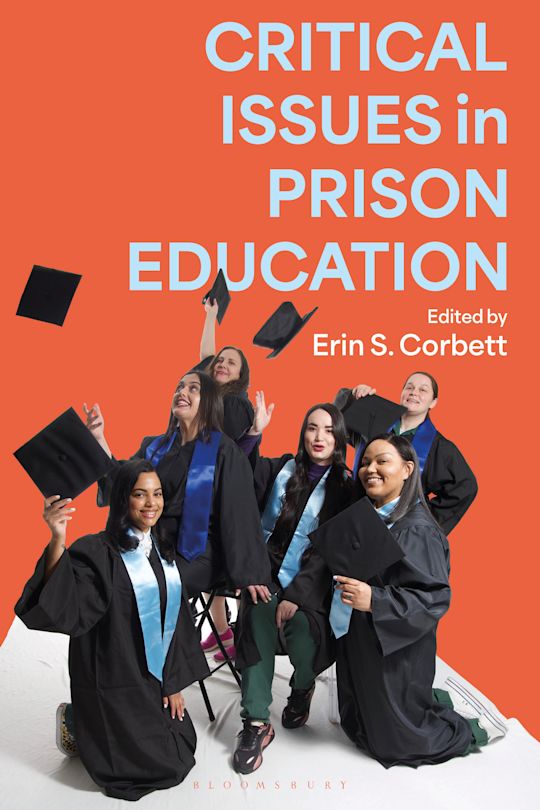

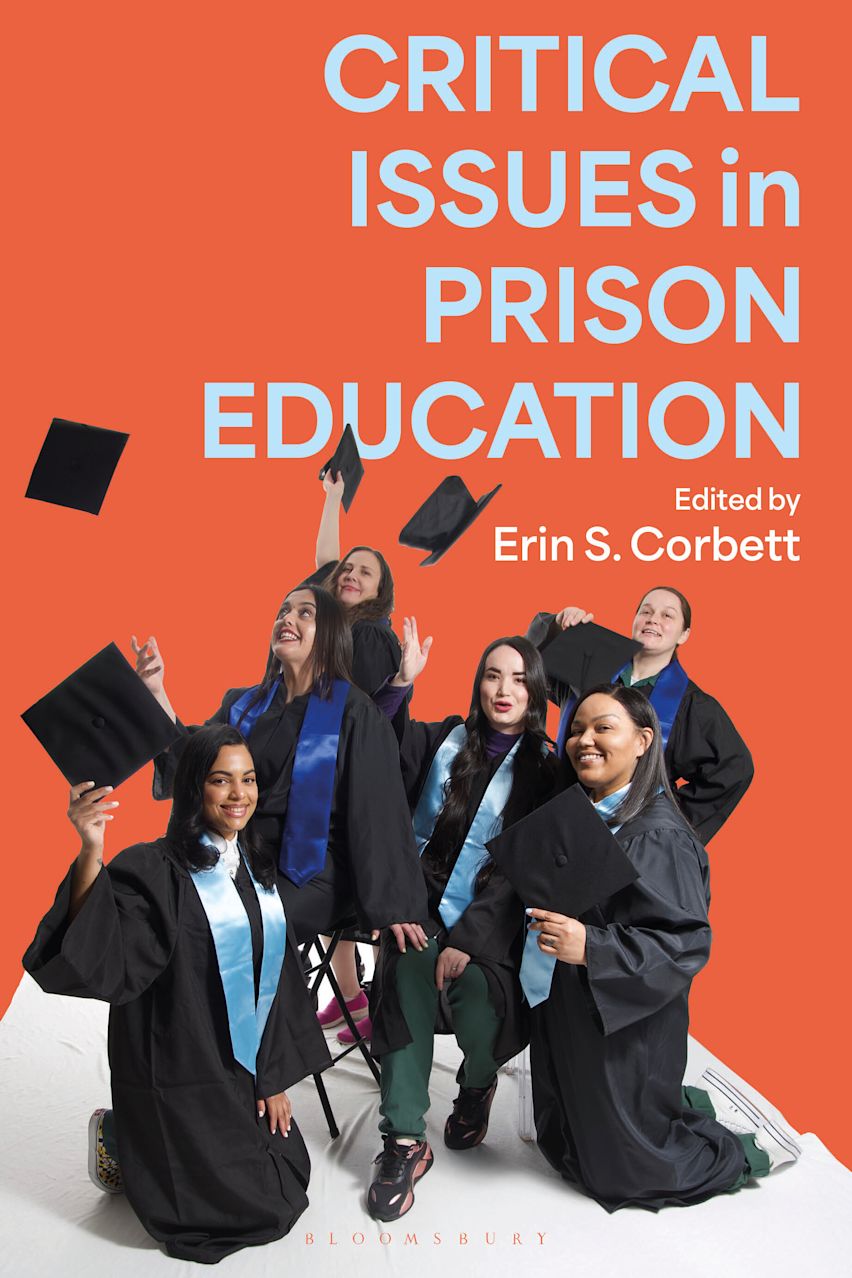
Critical Issues in Prison Education
Buying pre-order items
Ebooks and Audiobook
You will receive an email with a download link for the ebook or audiobook on the publication date.
Payment
You will not be charged for pre-ordered books until they are available to be shipped. Pre-ordered ebooks will not be charged for until they are available for download.
Amending or cancelling your order
For orders that have not been shipped you can usually make changes to pre-orders up to 72 hours before the publishing date.
Payment for this pre-order will be taken when the item becomes available
Description
This book critically surveys the key issues in prison education today. Including contributions from practitioners, activists, scholars, researchers, and advocates, the majority of whom are currently or formerly incarcerated, it considers current and future educational opportunity for confined learners. The US prison system is discussed in most detail and the book includes comparative chapters from researchers based in New Zealand and Tanzania. The contributors show how and why mass incarceration is the byproduct of the systemic denial of quality education to poor communities and communities of color in particular and discuss how the school-to-prison pipeline continues to disrupt the educational programming of children of color with increased exposure to law enforcement at younger ages. They consider how participatory action research can help to find solutions and look at how race/ethnicity/cultural affiliation play a role in the broader picture of mass incarceration as well as who does and does not have access to educational opportunities while inside. The chapters also cover issues of mental health, employment, trauma-informed pedagogy, digital and distance learning, leadership, university-prison partnerships, rehabilitations programs and the economics of prison education. The book offers practical solutions for educators and policy makers working to make prison education more equitable for systems-impacted people.
Accessibility Information
Additional accessibility information
- EPUB 3.0
- Conforms with the requirements of EPUB Accessibility Spec v1.1
- WCAG level AA
- WCAG v2.2 compliant
- accessibility@bloomsbury.com
Hazards
The publication contains no hazards
Support for non-visual reading
- No accessibility features offered by the reading system, device or reading software are disabled or otherwise unusable with the product
- Has alternative text descriptions for images
Visual adjustments
Appearance of the text and page layout can be modified according to the capabilities of the reading system (font family and size, spaces, as well as color of background and text)
Navigation
- Page list to go to pages from the print source version
- Elements such as headings, tables, etc for structured navigation
- All or substantially all textual matter is arranged in a single logical reading order
- Content is enhanced with ARIA roles to optimize organization and facilitate navigation
- Purposes of all links are made clear
Rich content
Language tagging provided
Table of Contents
Preface – Erin Corbett ((Second Chance Educational Alliance, USA)
Introduction – Maurice Blackwell
Part 1: Disrupting the Current Paradigm
1. 1. Checking In. Checking On. Checking Out: Infusing Mental Health Into the Carceral Classroom, Taylor C. Ford (Educator, USA)
2. 2. The Life and Times of an Incarcerated Mind, Alexander Bolling (incarcerated writer and education advocate, USA)
3. 3. Embodied Observers: The Indiana Women's Prison History Project and Its Implications for Optimizing the Delivery of STEM Programming in Carceral Settings, Michelle Daniel Jones (Constructing Our Future, USA)
4. 4. Beyond Utility: Towards the Development of a Philosophy of Prison Education, Hanan Al-Zubaidy (University of Oregon, USA)
5. 5. An Open Letter to Students/Alumni of Higher Education in Prison Programs, Rob Scott (Cornell University, USA)
6. 6. Igniting a New Research Future in HEP by Redefining Success, Peter Fulks (Cerro Coso Community College, USA)
Part 2: Reassigning Power and Expertise
7. 7. Positionality in PAR: Notes from a HEP Program Evaluation, Jarrod Wall & Katie Owens-Murphy (University of North Alabama, USA)
8. 8.Co-designing Support Post-Incarceration: Merits and Challenges of Participatory Evaluation Frameworks in Academic Reentry, Tess Pendergrast (Cornell Prison Education Program, USA), Sadé Lindsay (Cornell University, USA), and Lili Dodderidge (Cornell University, USA)
9. 9.The Policy-Culture Complex and the Phenomenology of Change: An Ethnography of the Impacts of Higher Education Inside Prisons, Alex Griffin (Cerro Coso Community College, USA)
10. 10. Kathy Boudin, Denise Carrascosa, and Ethnographic Jazz: Amefricanity Methodologies for Educational Justice in Prison, Caroline Bispo (Elas Existem, Brazil)
Part 3: The Human Experience
11. 11. A Father's Presence in Absence: Our Unbreakable Bond, Rodriguez A. Peake (incarcerated writer and education advocate, USA)
12. 12. Why Communication Studies Is Good for the Incarcerated, Dortell Williams ( Incarcerated writer, Cal State University Dominguez Hills, USA)
13. 13. Empowering Families Through Shared Literacy: Exploring Virtual Storytime for Incarcerated Parents, Nneka Uzoma Gigi-Patton (Kwenu Foundation, USA)
14. 14. Disability Access in Prison Education, Jenifer K. Montag (Marion Technical College, USA) & Ben Wright (The Community, USA)
15. 15. Reimagining (Dis)ability Management in Prisons Using a Porous Institution Logic, Mai Vang (independent researcher) & Mai Youa Lee (State of Minnesota, USA)
16. 16. Educational Wholeness: Urgent, Possible, Irresistible, emareena danielles (USA)
Part 4: Words Mean Things: Access is Not Equity
17. 17. A Third Option: The HUX MA Program and the Past, Present, and Future of Distance Education in Prison, Matthew S. Luckett (California State University, Dominguez Hills, USA)
18. 18. Standardizing Inter-Connected Technologies: A Framework for Advancing Human Rights and STEM Education, Michael A. Saine II (Prison to Professionals, USA)
19. 19. “Your Education is Voluntary.”: How California's Treatment of Prison Education Fails to Prepare Students for Successful Parole, Jesse Carson (incarcerated writer and education advocate, USA)
20. 20. The Transformative Journey of Higher Education in Prison and College Accessibility, Lyle C. May (Incarcerated Student, USA)
21. 21. Educational Parity in Higher Education in Prison Programs: Does it Exist? Michael Griggs (UCLA, USA), Douglas Weiss(California State University, San Bernardino, USA) & Annika Martinez (California State University, San Bernardino, USA)
Part 5: Liberation as Foundational Praxis
22. 22. The New Chains: Ascendium, Carceral Education, and the Machinery of Assimilation, Abraham Santiago Second Chance Educational Alliance, USA)
23. 23. If Country is Sick, Nothing Will Grow, Erin O'Donoghue (Curtin University, New Zealand)
24. 24. Designing User-Friendly Female Prisoner Rehabilitation and Empowerment Programmes at Kingolwira Prison in Tanzania's Morogoro region, Valeria Kyumana (Institute of Finance Management, Tanzania)
25. 25. The Yard: A Cultural Epicenter at the Intersection of HBCU & Carceral Reality, Britany J Gatewood (Liberation and Justice Project Foundation, Inc., USA) Bahiyyah Muhammad (Howard University, USA) & Anthony Jackson (Bowie State University, USA)
26. 26 An Examination of Prison Postsecondary Education Programming in Mississippi: An HBCU Perspective, Kathie Golden (Mississippi Valley State University, USA)
Product details

| Published | Apr 15 2027 |
|---|---|
| Format | Ebook (Epub & Mobi) |
| Edition | 1st |
| Pages | 288 |
| ISBN | 9781350563643 |
| Imprint | Bloomsbury Academic |
| Publisher | Bloomsbury Publishing |
Related Titles