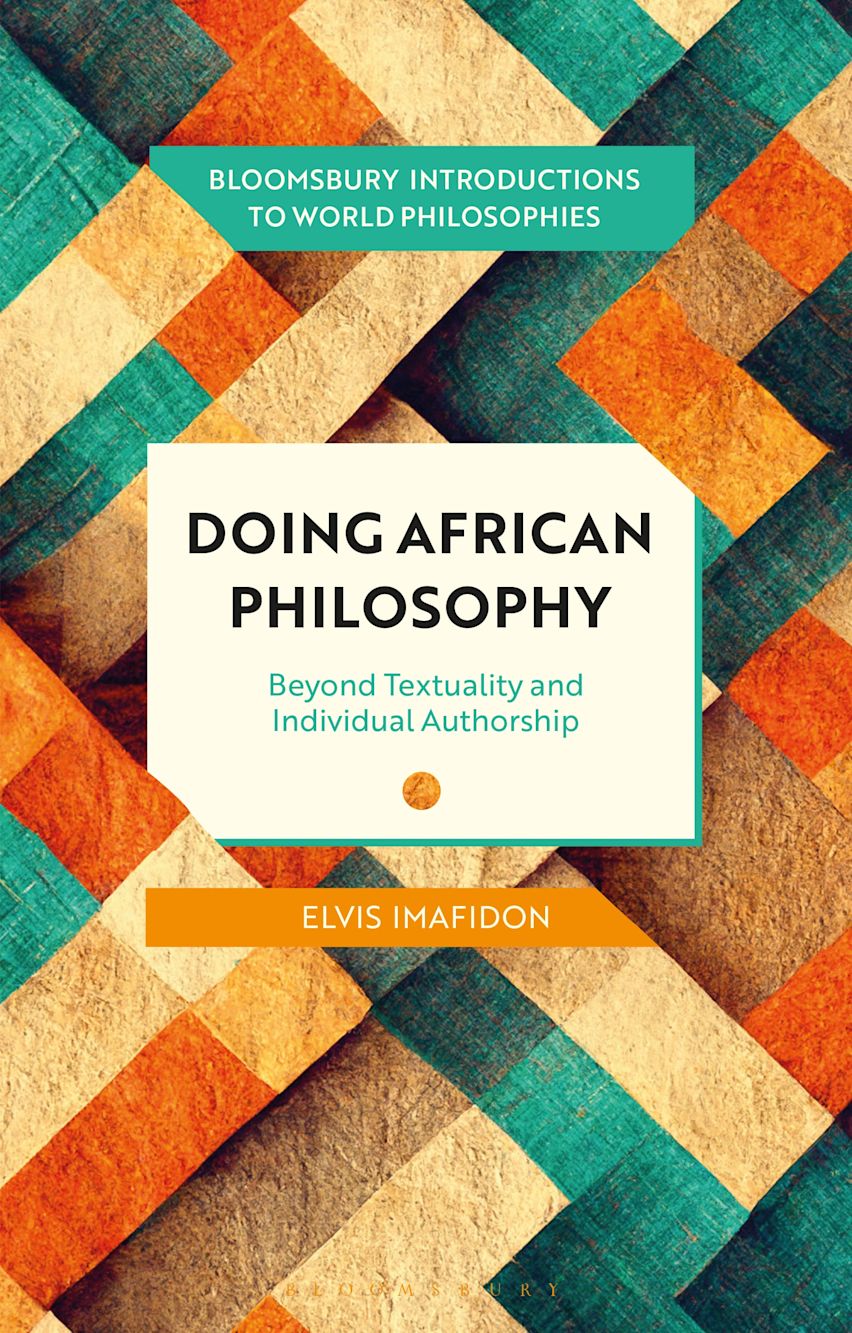
Doing African Philosophy
Beyond Textuality and Individual Authorship


Doing African Philosophy
Beyond Textuality and Individual Authorship
Description
What defines a philosophical tradition? The primacy of the written text and individual authorship are two major defining and interwoven credentials that have been used to deny African philosophical thought prior to the postcolonial phase. In this significant contribution to the search for identity and authenticity of African philosophy, Elvis Imafidon questions the relevance of authorship and textuality in the production, storage and transmission of knowledge. Drawing from the rich and robust philosophical heritages of sub-Saharan African traditions, he showcases the many non-textual and textual ways philosophy is collaboratively and intersubjectively done and critiqued.
His focus is on two major repositories of philosophical knowledges: orality and symbolism. Storytelling, adages, names and naming, folklores, proverbs and forms of symbolically encoded knowledges found in artefacts, symbols, textile patterns, motifs and corporeal and performative arts contest dominant narratives. They ask us to rethink the logic of binaries between literacy and illiteracy, text and non-text, and speech and writing.
Paying close attention to the Binis and Esans in Southern Nigeria, the Akans and Gas in Ghana, the Shonas in Zimbabwe, and the Zulu people in South Africa, Imafidon affirms the place of orality, symbolic art and different indigenous methods for philosophising. Exploring the concept of street philosophy in Nigeria, we see how oral and symbolic forms of philosophizing persist in modern African societies.
This much-needed book reclaims the voices, agency and narratives of African thought across history revealing the deeply embedded intersubjective and ecocentric Intellegence, and enigmatics of African philosophy. It challenges our understanding of the discipline of Philosophy and argues for an inclusive definition of philosophy in our trans-human, trans-textual age.
Accessibility Information
Additional accessibility information
- EPUB 3.0
- Conforms with the requirements of EPUB Accessibility Spec v1.1
- WCAG level AA
- WCAG v2.2 compliant
- accessibility@bloomsbury.com
Hazards
The publication contains no hazards
Support for non-visual reading
- No accessibility features offered by the reading system, device or reading software are disabled or otherwise unusable with the product
- Has alternative text descriptions for images
Visual adjustments
Appearance of the text and page layout can be modified according to the capabilities of the reading system (font family and size, spaces, as well as color of background and text)
Navigation
- Page list to go to pages from the print source version
- Elements such as headings, tables, etc for structured navigation
- All or substantially all textual matter is arranged in a single logical reading order
- Content is enhanced with ARIA roles to optimize organization and facilitate navigation
- Purposes of all links are made clear
Rich content
Language tagging provided
Table of Contents
Series Editors Preface
Foreword by Michael Onyebuchi Eze
Preliminaries: Doing African Philosophy
Doing Philosophy
The African Way
Reimagining Identity
1. Redefining a Philosophical Tradition
The Dominant Understanding of a Philosophical Tradition
Contesting Individual Authorship
Contesting Textuality
Contesting the Politics of Naming and Transgenerational Coherency
Contesting Whiteness and Literacy
What is a Philosophical Tradition?
2. The Orality of African Philosophy
Oral Repositories of Philosophy
Orality, Transgenerationality and Epistemic Reliability
Language, Orality and Truth
Names and the Philosophy of Human Existence
Oralising Relationality
3.Symbolism and African Philosophy
Problematising the Aesthetic Hermeneutical Encounter
Creating, Performing and Curating Philosophy
Symbolising Ontological Commitments
Symbolising Individuality in Relationality
Symbolising Knowing and Learning
4.The Textuality of African Philosophy
Legacies
Resistance
Defence
Mirroring
Doing
5.Trans-textuality and Collaborative Strategies
Trans-textuality and the Crisis of Relevance
Afro-communitarianism as Method toward Ecocentric Intellectuality
Relationality, Fluidity and Difference
Collaborative Research and Pedagogies
On Polemics and Enigmatics
6.Contemporaneities and Futures: On Street Philosophy
Acknowledging Contemporaneity: Philosophy in the Streets
Japa, Sapa and the Philosophy of Migration
“School na Scam”: Critiquing Education
Reimagining Futures
References
Index
Product details

| Published | Jan 22 2026 |
|---|---|
| Format | Ebook (Epub & Mobi) |
| Edition | 1st |
| Pages | 240 |
| ISBN | 9781350464254 |
| Imprint | Bloomsbury Academic |
| Series | Bloomsbury Introductions to World Philosophies |
| Publisher | Bloomsbury Publishing |

Reviews

ONLINE RESOURCES
Bloomsbury Collections
This book is available on Bloomsbury Collections where your library has access.
Related Titles