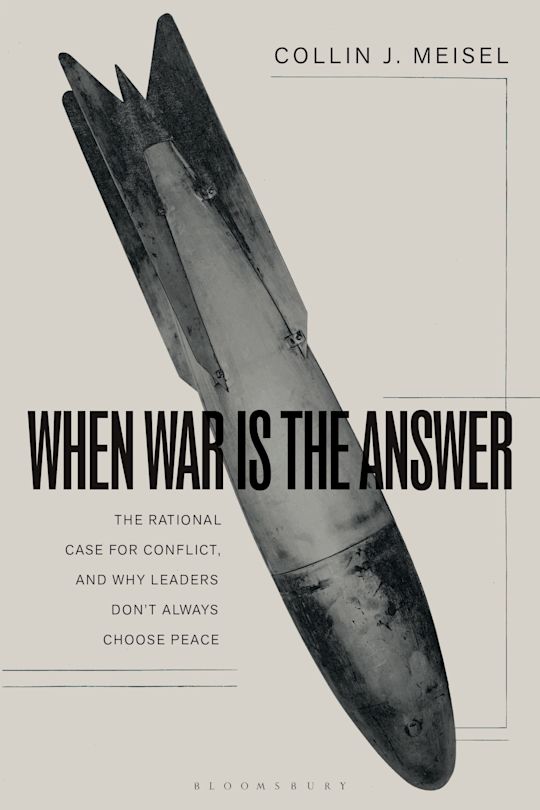
When War Is the Answer
The Rational Case for Conflict, and Why Leaders Don't Always Choose Peace

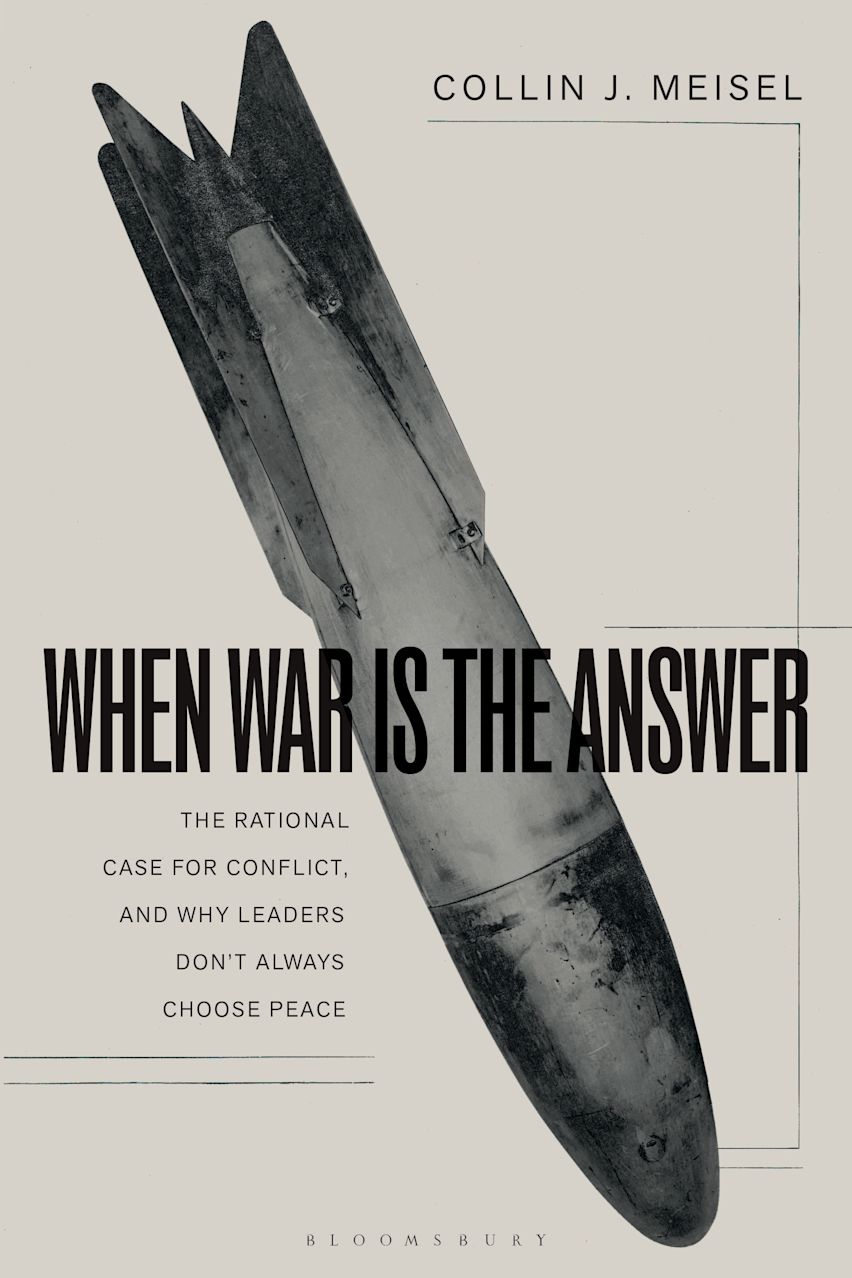
When War Is the Answer
The Rational Case for Conflict, and Why Leaders Don't Always Choose Peace
Buying pre-order items
Ebooks and Audiobook
You will receive an email with a download link for the ebook or audiobook on the publication date.
Payment
You will not be charged for pre-ordered books until they are available to be shipped. Pre-ordered ebooks will not be charged for until they are available for download.
Amending or cancelling your order
For orders that have not been shipped you can usually make changes to pre-orders up to 72 hours before the publishing date.
Payment for this pre-order will be taken when the item becomes available
Description
Through an investigation of political leaders' decision-making on the path to war, this timely book addresses one of the most important and misunderstood issues of our time: the preference for war over peace.
“Suicide for fear of death” is how the first chancellor of the German empire Otto von Bismarck described a leader's choice to start a war. In the lead up to World War I, the phrase “'The Germans are dangerous, but they are not maniacs" is how people assured one another they were safe. Indeed, beyond immediate self-defense against an obviously imminent attack, the decision to start a war may seem to most of us to be utterly irrational given its exorbitant costs-human, financial, psychological, moral, and otherwise. Why, then, have many leaders decided that war is the answer to their questions of how best to achieve their personal and policy objectives? What drives leaders to choose war in the future? How can we deter them?
Security and military expert Collin Meisel addresses these perplexing questions, offering a theory of war and testing it across five cases studies. Rather than try to predict, this book seeks to explain and understand these rationales, guiding readers through leaders' decision-making on the path toward war and gleaning lessons for the future. When we better understand why leaders make such drastic choices against far less bloody alternatives, we may be able to better understand how to shape choices in the future, perhaps reducing the frequency (if not bringing about the long-desired end) of war.
Accessibility Information
Additional accessibility information
- EPUB 3.0
- Conforms with the requirements of EPUB Accessibility Spec v1.1
- WCAG level AA
- WCAG v2.2 compliant
- accessibility@bloomsbury.com
Hazards
The publication contains no hazards
Support for non-visual reading
- No accessibility features offered by the reading system, device or reading software are disabled or otherwise unusable with the product
- Has alternative text descriptions for images
Visual adjustments
Appearance of the text and page layout can be modified according to the capabilities of the reading system (font family and size, spaces, as well as color of background and text)
Navigation
- Page list to go to pages from the print source version
- Elements such as headings, tables, etc for structured navigation
- All or substantially all textual matter is arranged in a single logical reading order
- Content is enhanced with ARIA roles to optimize organization and facilitate navigation
- Purposes of all links are made clear
Rich content
Language tagging provided
Table of Contents
Preface
Chapter 1: Why choose war?
Chapter 2: The rational choice of war
Chapter 3: Some complications for a rational choice theory of war…
Chapter 4: …And some necessary simplifications
Chapter 5: American declaration of war in 1812
Chapter 6: Japan's attack on Pearl Harbor
Chapter 7: America's war in Vietnam
Chapter 8: Russia's full-scale invasion of Ukraine
Chapter 9: A hypothetical Chinese invasion of Taiwan
Chapter 10: Lessons
Product details

| Published | Jan 21 2027 |
|---|---|
| Format | Ebook (Epub & Mobi) |
| Edition | 1st |
| Pages | 208 |
| ISBN | 9798216451624 |
| Imprint | Bloomsbury Academic |
| Publisher | Bloomsbury Publishing |

Related Titles