The Age of Geoeconomics
How the Logic of International Economics and Politics is Changing
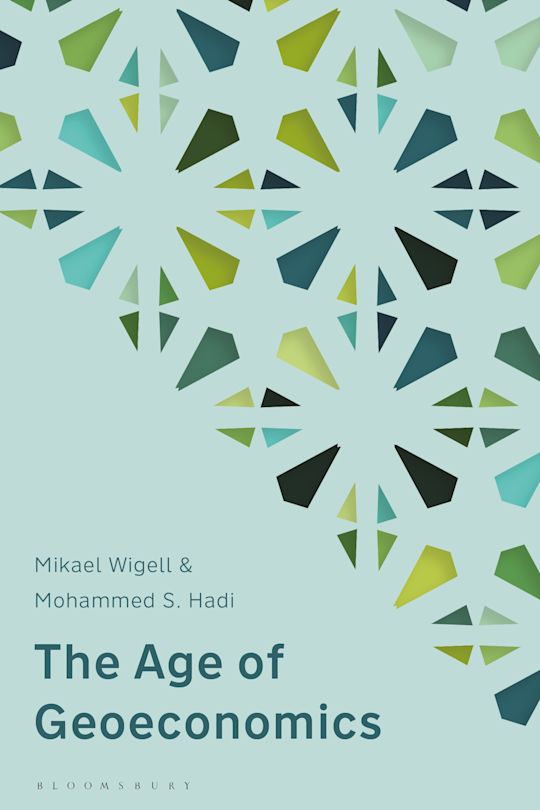


The Age of Geoeconomics
How the Logic of International Economics and Politics is Changing
Buying pre-order items
Ebooks and Audiobook
You will receive an email with a download link for the ebook or audiobook on the publication date.
Payment
You will not be charged for pre-ordered books until they are available to be shipped. Pre-ordered ebooks will not be charged for until they are available for download.
Amending or cancelling your order
For orders that have not been shipped you can usually make changes to pre-orders up to 72 hours before the publishing date.
Payment for this pre-order will be taken when the item becomes available
This product is usually dispatched within 1 week following the publication date
- Delivery and returns info
-
Free CA delivery on orders $40 or over
Description
Why are the world's major powers treating semiconductors as strategic assets, supply chains as vulnerabilities, and trade and investment as instruments of power? What changed – and what does it mean for the future of globalization?
For decades, the global economy was shaped by the expectation that markets would become increasingly integrated and that economic interdependence would foster prosperity and cooperation. Today, that assumption is giving way to a new reality. Governments are increasingly seeking not simply to benefit from interdependence, but to shape it strategically.
In The Age of Geoeconomics, Mikael Wigell and Mohammed S. Hadi explain this transformation and provide a new framework for understanding it. At its heart is a struggle over the balance of dependence: who depends on whom, for what, and with what consequences for power. States are seeking to reduce dependencies that make them vulnerable while cultivating forms of dependence that give them leverage over others. Trade, finance, technology, investment, energy and supply chains have consequently become central arenas of geopolitical competition.
The authors show how governments navigate this new landscape through different geoeconomic strategies – from coercing rivals and hedging against vulnerabilities to binding partners more closely and driving wedges between competing coalitions. These strategies are reshaping relationships between states and markets and giving rise to what the book calls strategic capitalism: an economic order in which security, power and geopolitical positioning increasingly influence decisions once governed predominantly by market considerations.
Drawing together international politics, economics and business, The Age of Geoeconomics offers a compelling guide to the forces transforming the global economy, and a framework for understanding the emerging world order.
Table of Contents
1. How the economy became too important to be left to economists
Part I From balancing power to balancing dependence: The changing logic of international politics
2. The rise of geoeconomics in the Second Cold War
3. Geoeconomic statecraft
4. The new geoeconomic order
Part II From market to strategic capitalism: The changing logic of international economics
5. The digitalization of the economy
6. The decarbonization of the economy
7. The weaponization of the economy
8. The securitization of the economy
9. The balkanization of the economy
10. The emergence of strategic capitalism
Notes
Index
Product details

| Published | Nov 12 2026 |
|---|---|
| Format | Hardback |
| Edition | 1st |
| Pages | 296 |
| ISBN | 9781350583023 |
| Imprint | Bloomsbury Academic |
| Dimensions | 246 x 189 mm |
| Publisher | Bloomsbury Publishing |
Reviews

ONLINE RESOURCES
Bloomsbury Collections
This book is available on Bloomsbury Collections where your library has access.
Related Titles