The Arden Encyclopedia of Shakespeare's Language
Semantic Fields and Social Status
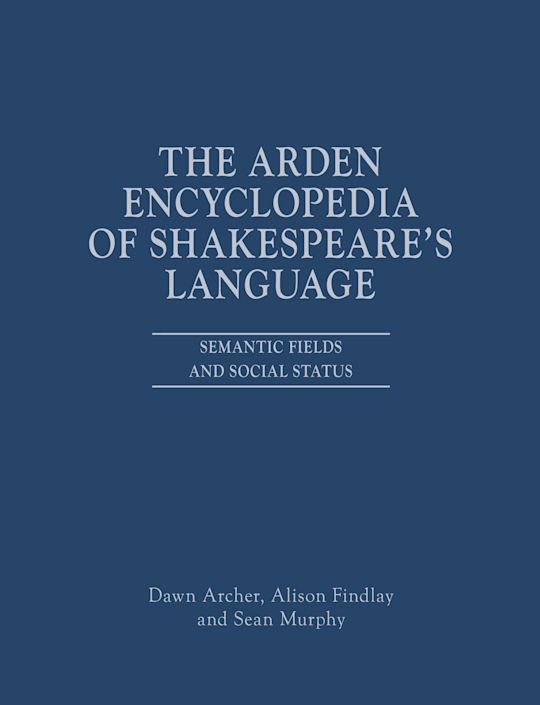

The Arden Encyclopedia of Shakespeare's Language
Semantic Fields and Social Status
Buying pre-order items
Ebooks and Audiobook
You will receive an email with a download link for the ebook or audiobook on the publication date.
Payment
You will not be charged for pre-ordered books until they are available to be shipped. Pre-ordered ebooks will not be charged for until they are available for download.
Amending or cancelling your order
For orders that have not been shipped you can usually make changes to pre-orders up to 72 hours before the publishing date.
Payment for this pre-order will be taken when the item becomes available
- Delivery and returns info
-
Free CA delivery on orders $40 or over
Description
The Encyclopedia of Shakespeare's Language Volume 5 brings scholarship on Shakespeare's language fully into the 21st-century. It is one of five volumes offering the first comprehensive account of Shakespeare's language to use computational methods derived from corpus linguistics – methods of choice for today's lexicographer. Volume 5 focuses on patterns of words in play genres (tragedy, history, comedy); socially defined character groups (e.g. male/female; noble/professional/servant; English/Welsh/Irish); and themes that are statistically characteristic of Shakespeare as a whole.
The encyclopedia uses a semantic tagger to allocate words and expressions to semantic categories such as 'warfare', 'love' and 'life'. Analysis of the resulting empirical data shows the semantic categories that characterize play genres, social groups and themes. For example, love comedies that are characterised by the most obviously love-related semantic category, 'intimate relationship'. Love tragedies, by contrast, are characterised by categories far removed from love: 'warfare', 'death', and so on. Closer inspection of the results reveals many points of interest. For example, the appearance of the semantic category 'plants' as highly characteristic of comedies may seem puzzling. In fact, it encodes a metaphorical connection with love, as it reflects underlying metaphorical patterns such a 'sex is agriculture' (cf. crop, reap) or 'food is love' (cf. feed, honey).
Table of Contents
INTRODUCTION TO VOLUME V
Linguistic profiles relating to genre
Linguistic profiles relating to gender and social stratification
Linguistic profiles relating to concepts and themes
The keywords method
A “Top Down” and “Bottom Up” Approach
GENRE
Linguistic profile for Comedies
Linguistic profile for Histories
Linguistic profile for Tragedies
GENDER AND SOCIAL STRATIFICATION IN SHAKESPEARE
Male/female differences in the Shakespeare plays
Higher/lower status differences in the Shakespeare plays
CONCEPTS AND THEMES
Notes
Index
Product details

| Published | Jun 24 2027 |
|---|---|
| Format | Hardback |
| Edition | 1st |
| Pages | 480 |
| ISBN | 9781350261983 |
| Imprint | The Arden Shakespeare |
| Illustrations | 206 bw illus |
| Dimensions | 246 x 189 mm |
| Series | Arden Encyclopedia of Shakespeare's Language |
| Publisher | Bloomsbury Publishing |

Related Titles