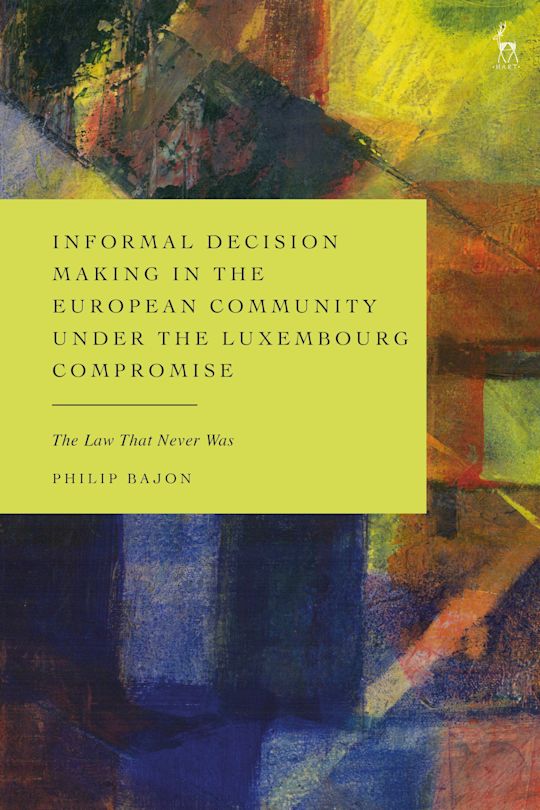
Informal Decision Making in the European Community under the Luxembourg Compromise
The Law That Never Was

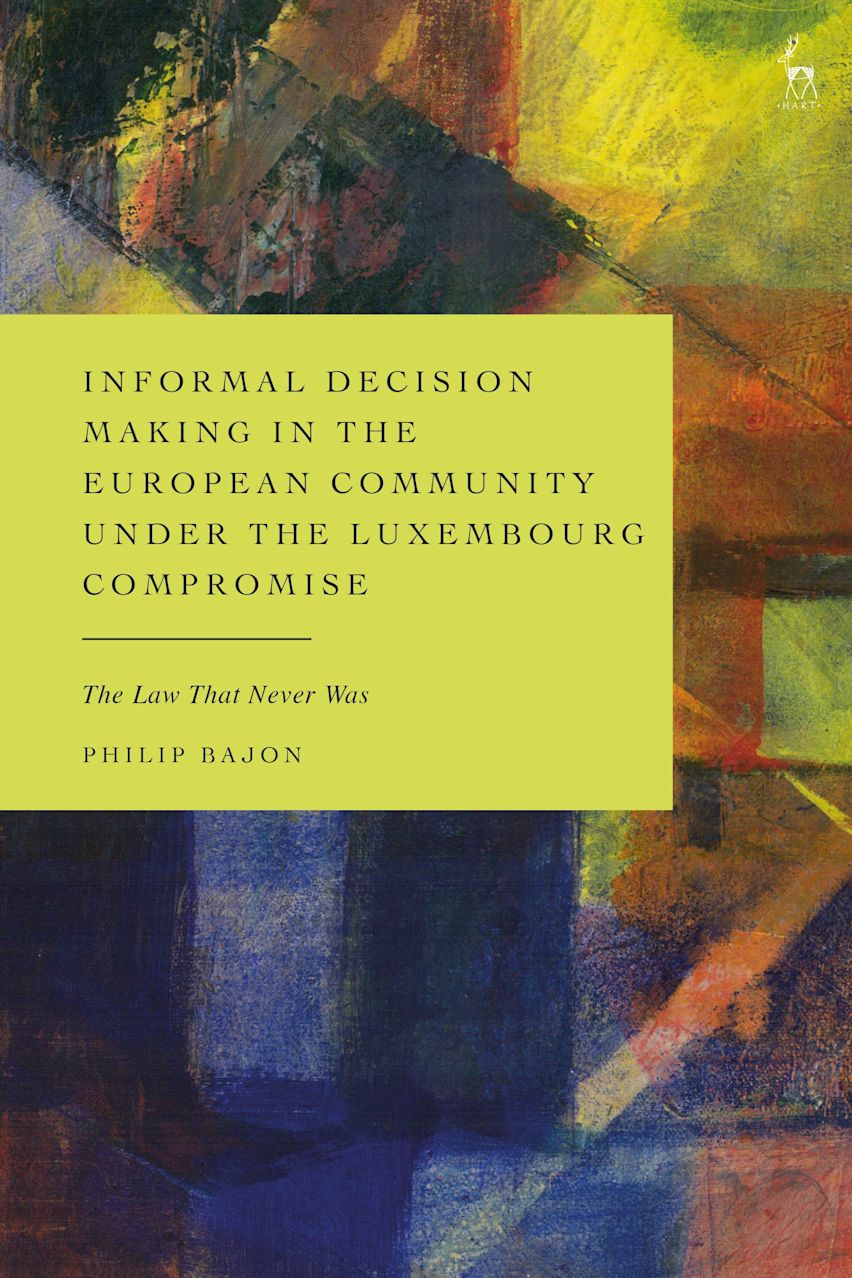
Informal Decision Making in the European Community under the Luxembourg Compromise
The Law That Never Was
Description
Runner-up of the 2026 SLS Margaret Brazier Prize for Outstanding Legal Scholarship
This book analyses the informal decision making process in the EU against the background of a gradually emerging European legal order.
Based on extensive multi-archival research in the UK, France, Germany, the Benelux countries and in Community institutions, the book explores the resistance against majority rule under the so-called Luxembourg Compromise of 1966, a European 'soft law' that allowed Member States to invoke 'vital national interests' and to veto legislation. This 'gentlemen's agreement' was never sanctioned or codified. However, as a 'rule of the game' it had a significant impact on the operations of the EU for several decades and became an integral part of the EU's 'consensus' approach. Its underlying rationale is still alive in the present-day EU.
Presenting a deeply revisionist account of European law and politics, the book demonstrates how the Luxembourg arrangement served as a compromise between the Treaty text and political reality, as a counterweight to technocratic ideas, and as a bridge between irreconcilable divides over European unification.
It includes case studies from 1965 - 2000, such as the 'Eurosclerosis' of the 1970s, British exceptionalism as an EU member, the European revival of the mid-1980s, and intergovernmentalism on the verge of negotiating the Maastricht Treaty.
Highly original in its interdisciplinary, comprehensive and archivally-rooted method, the book interrogates the most important and controversial debates about the past, present and future of the European Union.
Accessibility Information
Additional accessibility information
- EPUB 3.0
- Conforms with the requirements of EPUB Accessibility Spec v1.1
- WCAG level AA
- WCAG v2.2 compliant
- accessibility@bloomsbury.com
Hazards
The publication contains no hazards
Support for non-visual reading
- No accessibility features offered by the reading system, device or reading software are disabled or otherwise unusable with the product
- Has alternative text descriptions for images
Visual adjustments
Appearance of the text and page layout can be modified according to the capabilities of the reading system (font family and size, spaces, as well as color of background and text)
Navigation
- Page list to go to pages from the print source version
- Elements such as headings, tables, etc for structured navigation
- All or substantially all textual matter is arranged in a single logical reading order
- Content is enhanced with ARIA roles to optimize organization and facilitate navigation
- Purposes of all links are made clear
Rich content
Language tagging provided
Table of Contents
1. The 'Empty Chair' Crisis
2. Suspending the Transition to Majority Voting
3. Decision-Making Sociology after the 'Empty Chair'
Part 2: Transition 1972–78
4. British Accession
5. The Lifting of the 'Culture of Unanimity' in the Mid–1970s
6. The Tindemans Report
7. Southern Enlargement
8. The Three Wise Men Report
Part 3: Transformation 1978–84
9. Reconceptualising the Compromise
10. A Case Law History
11. The Search for Clarification
Part 4: Trade-Off 1984–86
12. The European Revival of 1984
13. The Dooge Committee and the Reception of its Report
14. The Milan European Council of 1985
15. The Single European Act
Part 5: Towards Maastricht Europe and Beyond 1986–2016
16. The SEA Ratification Debates
17. The Council Internal Rules of Procedure
18. The 'Evocability' of the Compromise
19. The Maastricht Treaty and the GATT
20. The Compromise in Today's European Union
Product details
| Published | Oct 16 2025 |
|---|---|
| Format | Ebook (Epub & Mobi) |
| Edition | 1st |
| Pages | 352 |
| ISBN | 9781509982844 |
| Imprint | Hart Publishing |
| Publisher | Bloomsbury Publishing |

ONLINE RESOURCES
Bloomsbury Collections
This book is available on Bloomsbury Collections where your library has access.
Related Titles