
Buying pre-order items
Ebooks and Audiobook
You will receive an email with a download link for the ebook or audiobook on the publication date.
Payment
You will not be charged for pre-ordered books until they are available to be shipped. Pre-ordered ebooks will not be charged for until they are available for download.
Amending or cancelling your order
For orders that have not been shipped you can usually make changes to pre-orders up to 72 hours before the publishing date.
Payment for this pre-order will be taken when the item becomes available
- Delivery and returns info
-
Free CA delivery on orders $40 or over
Description
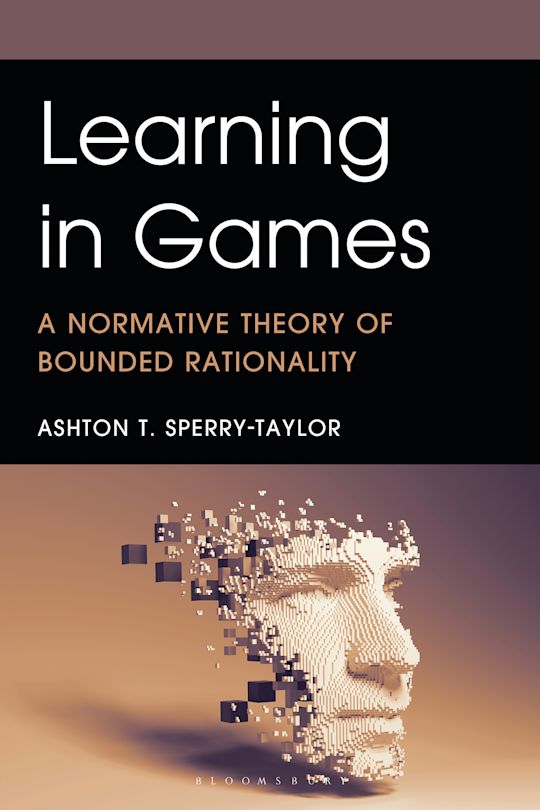
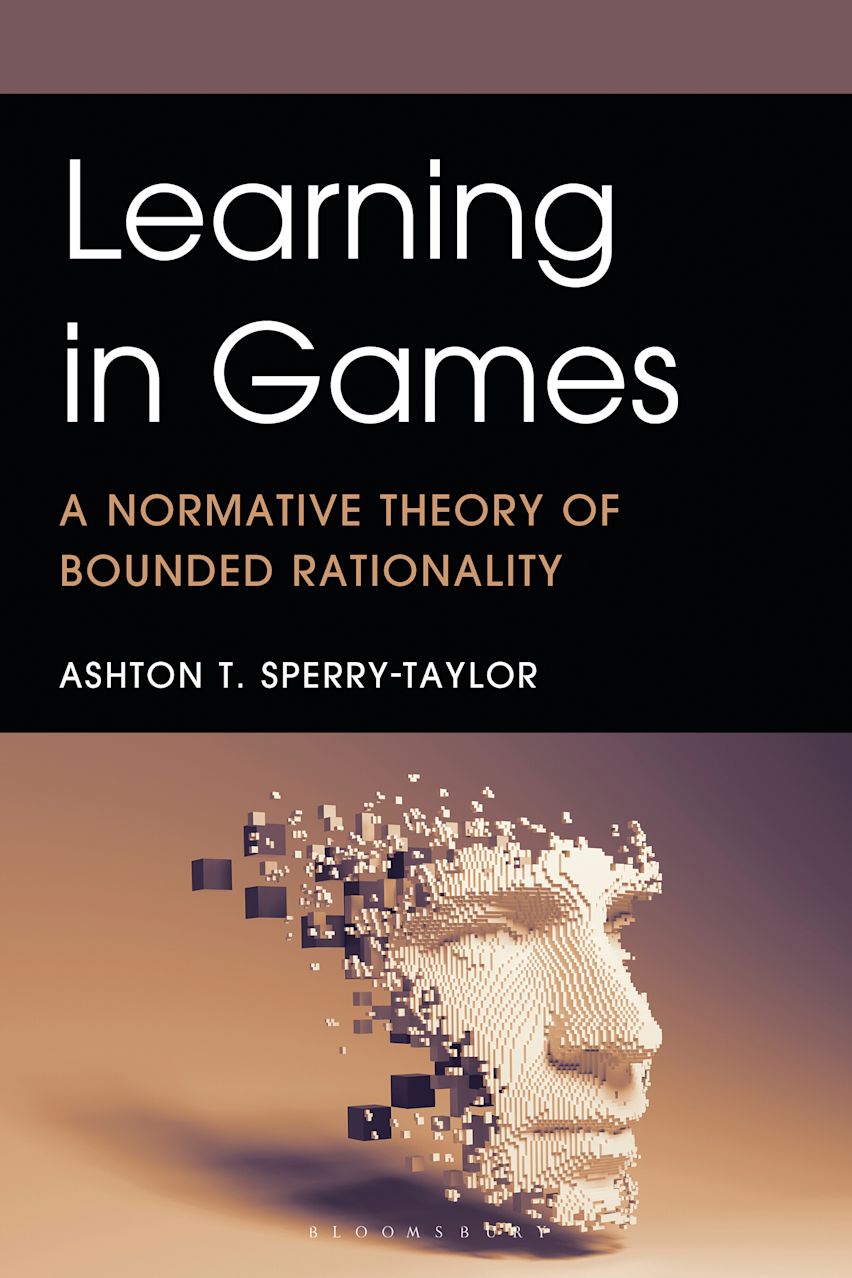
Game theory prescribes strategies based on reasoning that is often beyond the reach of bounded players. This book identifies when they can learn their way to equilibrium-and when they cannot.
Game theory traditionally assumes that players have no cognitive limits and fully know their strategic circumstances. Without those assumptions, equilibrium reasoning no longer guides their decisions. Existing approaches to bounded rationality-ecological rationality, epistemic game theory, evolutionary models, the learning-in-games tradition, and procedural rationality-offer no unified account of how players should learn in uncertain, changing environments or when learning converges to equilibrium.
Ashton T. Sperry-Taylor introduces strategic bandits, which model an opponent using a memory-m rule: the opponent's next move depends on the preceding m rounds. Decision policies have precise convergence conditions. Action-level learning succeeds when players identify the best fixed action and when conditional responses offer no additional value. At the strategic boundary, a conditional policy outperforms every fixed action, even when players learn the best one. At the estimation boundary, the learning process prevents players from identifying that best fixed action.
Sperry-Taylor develops his account through five games: the prisoner's dilemma, the centipede game, the stag hunt, divide the cake, and the battle of the sexes. Across them, bounded players learn their way to equilibrium, fail to coordinate because their payoff estimates mislead them, or learn more slowly to protect against an unpredictable opponent. He distinguishes between difficulties arising from the strategic situation and those arising from the learning process itself.
Table of Contents
Chapter 1: Bounded Rationality and Learning in Games
Chapter 2: The Epistemic Relaxation Model
Chapter 3: Foundations of Reinforcement Learning and Stochastic Games
Chapter 4: Explanatory Underdetermination in Sequential Games
Chapter 5: Strategic Bandits and Learning in Games
Chapter 6: The Prisoner's Dilemma-Analytical Results
Chapter 7: The Prisoner's Dilemma-Empirical Results
Chapter 8: The Centipede Game-Analytical Results
Chapter 9: The Quasi-Centipede Game-Empirical Results
Chapter 10: The Stag Hunt-Analytical Results
Chapter 11: The Stag Hunt-Empirical Results
Chapter 12: Divide the Cake-Analytical Results
Chapter 13: Divide the Cake-Empirical Results
Chapter 14: Battle of the Sexes-Analytical Results
Chapter 15: Battle of the Sexes-Empirical Results
Appendix to Chapter 5: Technical Proofs and Finite-State Analysis
Appendix to Chapter 8: Technical Proofs for the Quasi-Centipede
References
Index
Product details

| Published | Apr 01 2027 |
|---|---|
| Format | Hardback |
| Edition | 1st |
| Pages | 256 |
| ISBN | 9781666981957 |
| Imprint | Bloomsbury Academic |
| Dimensions | 229 x 152 mm |
| Publisher | Bloomsbury Publishing |
Related Titles