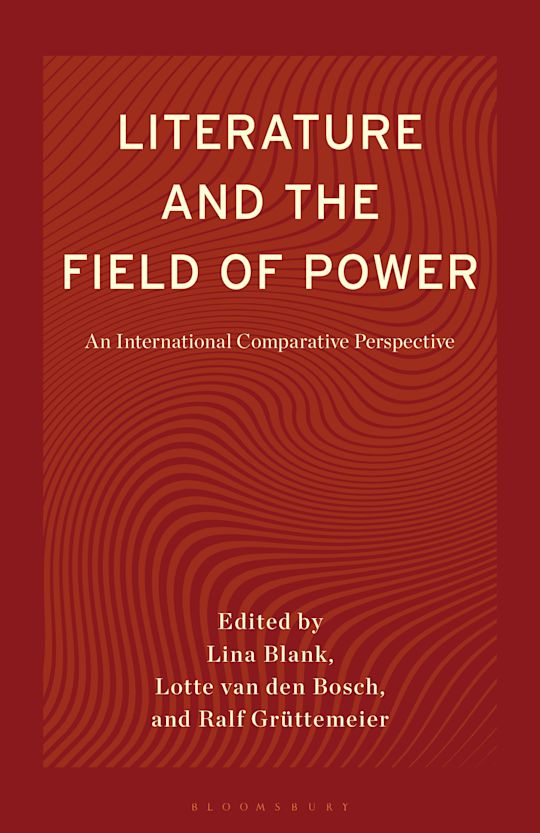
Literature and the Field of Power
An International Comparative Perspective

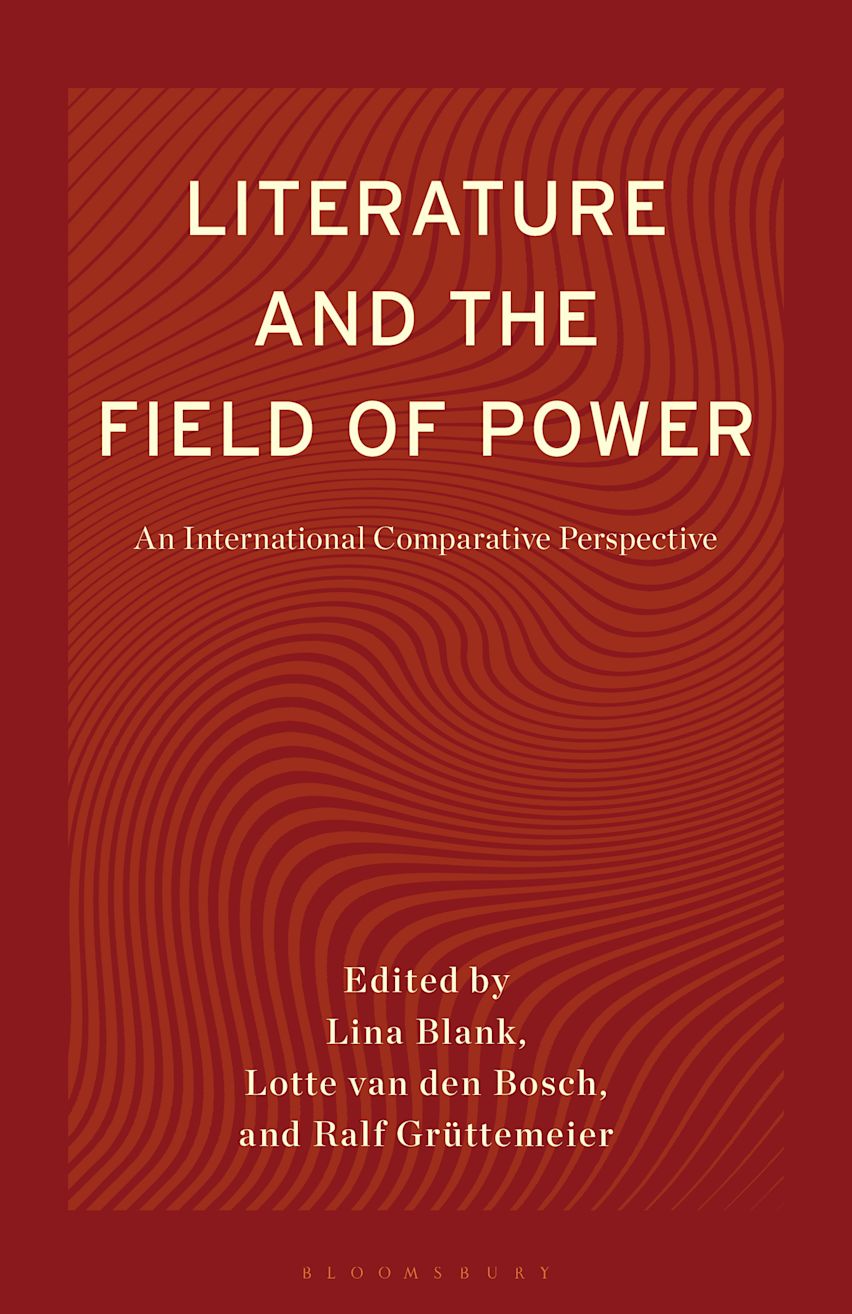
Literature and the Field of Power
An International Comparative Perspective
Buying pre-order items
Ebooks and Audiobook
You will receive an email with a download link for the ebook or audiobook on the publication date.
Payment
You will not be charged for pre-ordered books until they are available to be shipped. Pre-ordered ebooks will not be charged for until they are available for download.
Amending or cancelling your order
For orders that have not been shipped you can usually make changes to pre-orders up to 72 hours before the publishing date.
Payment for this pre-order will be taken when the item becomes available
Description
Draws on case studies from diverse national and historical contexts to explore the heuristic potential of Pierre Bourdieu's concept of the field of power in comparative literary studies and beyond.
While Bourdieu's work plays a vital role in sociological studies of literature, his concept of 'the field of power' remains underexplored. The authors in this volume argue that this concept can serve as a methodological tool for the relational analysis of specific fields, such as literature.
One of the strong sides of Bourdieuian field theory is that it allows for fruitful comparisons between national and transnational fields because of its power to systematically relate all relevant literary actors to each other – and to those of other fields. In order to further explore this perspective, Literature and the Field of Power includes case studies reaching from central Europe (France, Belgium, the Netherlands, Germany) via Eastern Europe (Belarus) to the Asia-Pacific (Japan, China) – not with any claim to representativity, but with the aim of presenting valuable case studies using this joint heuristic tool.
In chapters that touch on censorship, constitutional law, pedagogy, and authorship, authors reflect on the heuristic applicability of the concept of the field of power, thereby contributing to the sharpening of the concept as methodological tool that can be used to increase our knowledge of literature in relation to politics, law, the field of power, or even more general: literature in its societal context.
Accessibility Information
Additional accessibility information
- EPUB 3.0
- Conforms with the requirements of EPUB Accessibility Spec v1.1
- WCAG level AA
- WCAG v2.2 compliant
- accessibility@bloomsbury.com
Hazards
The publication contains no hazards
Support for non-visual reading
- No accessibility features offered by the reading system, device or reading software are disabled or otherwise unusable with the product
- Has alternative text descriptions for images
Visual adjustments
Appearance of the text and page layout can be modified according to the capabilities of the reading system (font family and size, spaces, as well as color of background and text)
Navigation
- Page list to go to pages from the print source version
- Elements such as headings, tables, etc for structured navigation
- All or substantially all textual matter is arranged in a single logical reading order
- Content is enhanced with ARIA roles to optimize organization and facilitate navigation
- Purposes of all links are made clear
Rich content
Language tagging provided
Table of Contents
Notes on Contributors
Acknowledgements
Introduction - There Is No Such Thing as an Uncensored Library: Toward a Better Understanding of the Relations of Literature and the Field of Power Lina Blank (University of Oldenburg, Germany), Lotte van den Bosch (Leiden University, The Netherlands) and Ralf Grüttemeier (University of Oldenburg, Germany)
Part I -The Embedding of National Literary Fields in the Field of Power
1. The Field of Power and the Differentiation of Fields: Theoretical and Sociohistorical Perspectives Gisèle Sapiro (EHESS Paris, France)
2. The Functions of Literature in Japan's Diet Edward Mack (University of Washington, USA)
3. The Fields of Power, Literature, and Language: The Case of Belarus Gun-Britt Kohler (University of Oldenburg, Germany)
Part II - Censorship and Citizenship: Literature in a Legal Context
4. Meta-Capital and the Creation and Protection of Dutch Polders: Art and Literature's Role in Naturalizing Legal Irresponsibility Frans-Willem Korsten (Leiden University, The Netherlands)
5. Censors as Agents in the Literary Field: Three Cases from Modern China Michel Hockx
Michel Hockx (University of Notre Dame, USA)
6. Constitutional Law and Literature: What Jurists Studying the Constitution (Could) Learn About Fiction Lotte van den Bosch (Leiden University, The Netherlands)
Part III - From Classroom to Parliament: Literature in a Political Context
7. Literature Between Politics and Education: The Representation of Power Relations in the Flemish Novel Arm Vlaanderen Pieter Verstraeten (KU Leuven, Belgium)
8. Strategic Referencing: Literature-Related Discussions in the Dutch, German, and Flemish Parliaments Lina Blank (University of Oldenburg, Germany)
9. A Fragile Alliance: Günter Grass and Willy Brandt in the Field of Power Around 1970 Markus Joch (Keio University Tokyo, Japan)
10. Dutch Politicians as Literary Authors: A Case Study on the Relations Between the Fields of Politics and Literature Ralf Grüttemeier (University of Oldenburg, Germany)
Index
Product details

| Published | Apr 01 2027 |
|---|---|
| Format | Ebook (Epub & Mobi) |
| Edition | 1st |
| Pages | 288 |
| ISBN | 9798216444664 |
| Imprint | Bloomsbury Academic |
| Illustrations | 12 bw illus |
| Publisher | Bloomsbury Publishing |
Related Titles