
Buying pre-order items
Ebooks and Audiobook
You will receive an email with a download link for the ebook or audiobook on the publication date.
Payment
You will not be charged for pre-ordered books until they are available to be shipped. Pre-ordered ebooks will not be charged for until they are available for download.
Amending or cancelling your order
For orders that have not been shipped you can usually make changes to pre-orders up to 72 hours before the publishing date.
Payment for this pre-order will be taken when the item becomes available
Description
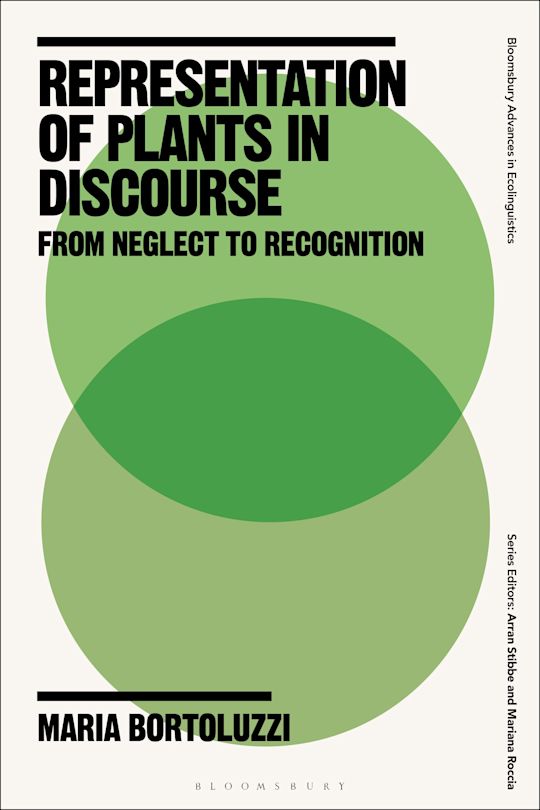
How do we communicate about plants in diverse socio-cultural contexts? Which underlying values and beliefs inform the positioning of plants in texts? Why is it essential to reflect on plant discourse at a time of climate crisis?
Plants are life-sustaining protagonists on the planet, and their immense relevance in ecosystems and in our lives cannot be overstated. Yet, plants tend to be given less consideration than animals because their organisms are very different from ours, and their movements and actions are difficult to perceive because of our sensory limitations and different timeframes. Therefore, plants are often neglected and backgrounded, or discursively constructed as exploitable resources and commodities, especially in technological and urbanised social contexts. This results in discursive representations informed by de-animating and exploitative beliefs that have negative cascading impacts on the web of life. Vice versa, respect for all participants in Earth ecosystems, including plants, can foster ecojustice and wellbeing for all.
This book analyses how we represent plants in a variety of socio-cultural and interactional contexts, in verbal and non-verbal texts. It discusses what these practices reveal about underlying values, and what impact these representations may have on the web of life. Since plant discourse has been under-represented in ecolinguistics so far, this study advocates for a plant turn in ecolinguistics, ecological discourse studies and ecomultimodality. Reflecting on how we speak and write about plants means giving recognition to the photosynthesising beings that sustain life on the planet.
Accessibility Information
Additional accessibility information
- EPUB 3.0
- Conforms with the requirements of EPUB Accessibility Spec v1.1
- WCAG level AA
- WCAG v2.2 compliant
- accessibility@bloomsbury.com
Hazards
The publication contains no hazards
Support for non-visual reading
- No accessibility features offered by the reading system, device or reading software are disabled or otherwise unusable with the product
- Has alternative text descriptions for images
Visual adjustments
Appearance of the text and page layout can be modified according to the capabilities of the reading system (font family and size, spaces, as well as color of background and text)
Navigation
- Page list to go to pages from the print source version
- Elements such as headings, tables, etc for structured navigation
- All or substantially all textual matter is arranged in a single logical reading order
- Content is enhanced with ARIA roles to optimize organization and facilitate navigation
- Purposes of all links are made clear
Rich content
Language tagging provided
Table of Contents
List of Tables
Acknowledgements
1. Why a Book about Plant Representation in Discourse?
2. Plants in Ecolinguistics and Ecomultimodality
3. Plants as Participants in Environmental Reports and News Discourse
4. Voices Mediating Indigenous Knowledge in Plant Discourse
5. Plants Embodied in Multimodal Texts
6. The Role of Plants in Ecocultural Learning
7. Plant Discourse for Promoting Positive Change
References
Appendix
Index
Product details

| Published | Oct 15 2026 |
|---|---|
| Format | Ebook (Epub & Mobi) |
| Edition | 1st |
| Pages | 208 |
| ISBN | 9781350505551 |
| Imprint | Bloomsbury Academic |
| Illustrations | 15 bw illus |
| Series | Bloomsbury Advances in Ecolinguistics |
| Publisher | Bloomsbury Publishing |

Reviews
Related Titles