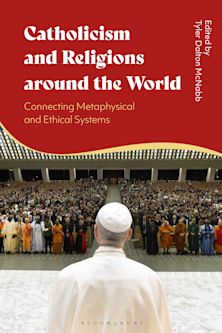
Catholicism and Religions around the World
Connecting Metaphysical and Ethical Systems



Catholicism and Religions around the World
Connecting Metaphysical and Ethical Systems
Description
A team of philosophers and theologians explore how religious traditions from around the world can expand Catholic faith and practices.
Placing a focus on dual membership and shared beliefs, this wide-ranging collection connects metaphysical and ethics systems across a range of traditions of faith. Covering Catholicism, Judaism, Islam, Hinduism, Buddhism and Daoism, it poses and addresses a range of questions: Are the philosophies of other religions consistent with the metaphysics and ethics of Catholicism? Can Catholics consistently belong to other religious traditions while remaining faithfully Catholic? To what extent can beliefs and rites from other religious traditions be incorporated into Catholicism? Each chapter offers optimistic and considered answers.
Drawing on analytic epistemology and comparative theology, this timely collection represents the spirit of unity reflected in post-Vatican II Catholicism. With an emphasis on constructive dialogue throughout, it provides essential reading for students and scholars interested in expanding the philosophy of religion and contemporary discussions of faith.
Table of Contents
Chapter 1: Nostra Aetate and Interreligious Dialogue by Catherine Cornille (Boston College, USA)
Chapter 2: Implicit Faith and the World Religions by Gregory R. Stacey (Saint Francis University, USA)
Chapter 3: Joseph Ratzinger's Christology of Religions by Matthew Ramage (Benedictine College, USA)
Chapter 4: Catholicism Vedanta by Daniel Soars (Eton College, UK)
Chapter 5: Catholicism and Mere Buddhism by Tyler Dalton McNabb (VinUniversity, Vietnam) and Erik Baldwin (Indiana University, Northwest, USA)
Chapter 6: Confucianism, Catholicism, and the Possibility of Rapprochement by Joshua Brown (Mount St. Mary's University, USA)
Chapter 7: Daoism and Catholicism by Victoria Harrison (University of Macau, Macau) and Rhett Gayle (University of Macau, Macau)
Chapter 8: Catholics and Jews by Gavin D'Costa (Pontifical University of St. Thomas Aquinas, Italy)
Chapter 9: Islam: Divine Faith or Natural Desire? By Wilhelmus Valkenberg (Catholic University of America, USA)
Chapter 10: How to be an Agnostic Catholic By Francis Jonbäck (The University of Gävle and Uppsala University, Sweden)
Product details
| Published | 18 Jul 2026 |
|---|---|
| Format | Paperback |
| Edition | 1st |
| Pages | 264 |
| ISBN | 9789369529612 |
| Imprint | Bloomsbury Academic India |
| Dimensions | 234 x 156 mm |
| Publisher | Bloomsbury Publishing India Pvt. Ltd |
Reviews

ONLINE RESOURCES
Bloomsbury Collections
This book is available on Bloomsbury Collections where your library has access.
Related Titles